What Moved the Market
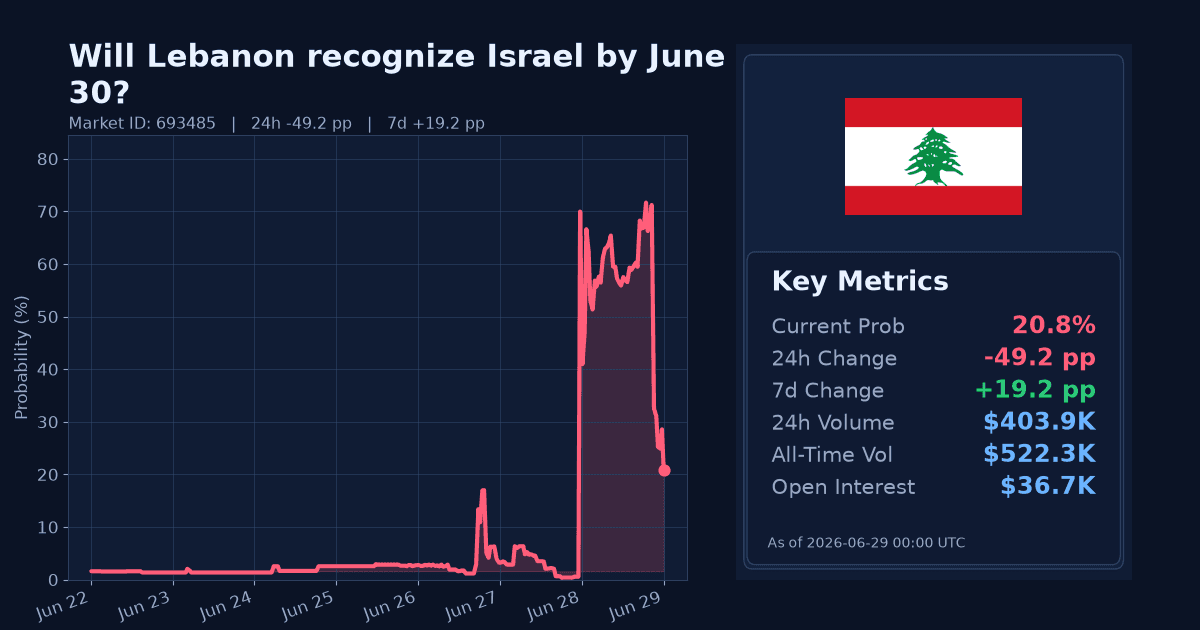
Lebanon recognizing Israel by June 30 is a time-bound contract that resolves only on a formal, official act of recognition between November 20, 2025 and June 30, 2026, 11:59pm ET. Over the past 24 hours, the market price fell sharply by 49.15 percentage points to 20.8%.
Despite this one-day drop, the contract remains up 19.2 percentage points versus a week ago, indicating unusually large swings within the final days of the resolution window.
Why It Likely Moved
- The repricing follows reporting of U.S.–Iran exchanges of strikes alongside escalating clashes between Israel and Hezbollah on June 28, which markets appear to interpret as reducing near-term prospects for a diplomatic breakthrough before the cutoff, according to NPR.
- Markets reacted to AP News (June 28) noting pressure on Syria to confront Hezbollah, which raised alarm in Lebanon and Israel; traders appear to be marking down the probability of formal recognition under heightened conflict risk.
- The UK government (published June 26, 2026) highlighted support for the Lebanese Armed Forces and discussions on a durable ceasefire. The focus on ceasefire mechanics, rather than state-to-state recognition, may have reinforced expectations that recognition is not imminent.
- With the June 30, 2026 deadline approaching and the market requiring a formal act (not intentions) to resolve “Yes,” traders appear to have discounted the likelihood of such an official step occurring in time.
How Strong the Move Is
The 24-hour move is classified as extreme: a 49.15 percentage-point decline with a 24h z-score of 183.8 indicates an outsized, deadline-proximate repricing rather than routine volatility. Liquidity conditions do not appear impaired (0.1 pp spread), suggesting a broad-based adjustment rather than price dislocation.
On a 7-day basis, the market still shows an extreme upward shift (z-score 77.0), implying a volatile week punctuated by a sharp reversal into the final days of the contract window. The pattern is consistent with a spike earlier in the week followed by an abrupt de-risking.
Cross-Market Confirmation
- Israel withdraws from Lebanon by July 31, 2026: down 0.15 pp (24h) and down 8.2 pp (7d), aligning with skepticism about near-term de-escalation steps.
- US–Iran Final Nuclear Deal by Sept 30, 2026: down 0.5 pp (24h), a mild decline consistent with rising geopolitical tension.
- Kharg Island no longer under Iranian control by July 31: down 0.3 pp (24h) and down 0.8 pp (7d), a small move that neither confirms a broad crisis repricing nor contradicts the main move.
News & Real-World Context
- On June 28, the U.S. and Iran exchanged strikes while violence escalated between Israel and Hezbollah along the Lebanon–Israel border, raising regional risk and complicating diplomacy, per NPR.
- Also on June 28, AP News reported pressure on Syria to confront Hezbollah, which alarmed officials in Lebanon and Israel due to escalation risks.
- As an official policy signal, the UK government (June 26, 2026) stated discussions with Lebanon’s army commander focused on UK support for the Lebanese Armed Forces and progress toward a durable ceasefire—indicating active security and stabilization efforts but not touching on diplomatic recognition.
Macro context: Brent crude is $72.93/bbl, down 8.7% over the week and 20.8% over the month, while the VIX is 18.41, up 12.3% over the week. Energy markets are not signaling an immediate supply shock, whereas equity volatility is modestly elevated—consistent with an event-specific geopolitical repricing rather than a broad macro dislocation.
Bottom Line
The sharp drop reflects markets marking down the probability of a formal Lebanese recognition of Israel before the June 30 cutoff amid fresh escalation signals and the contract’s strict requirement for an official act. The move looks deadline-driven and event-specific; absent an official announcement, odds are likely to remain subdued into expiry.
Market Conditions at Time of Writing
- Current Probability: 20.8%
- 24h Change: -49.15 pp
- 7d Change: 19.2 pp
- Volume (24h, $): 403,880.43
- Open Interest ($): 36,652.49
- Spread (pp): 0.1
- Z-score (24h): 183.8