What Moved the Market
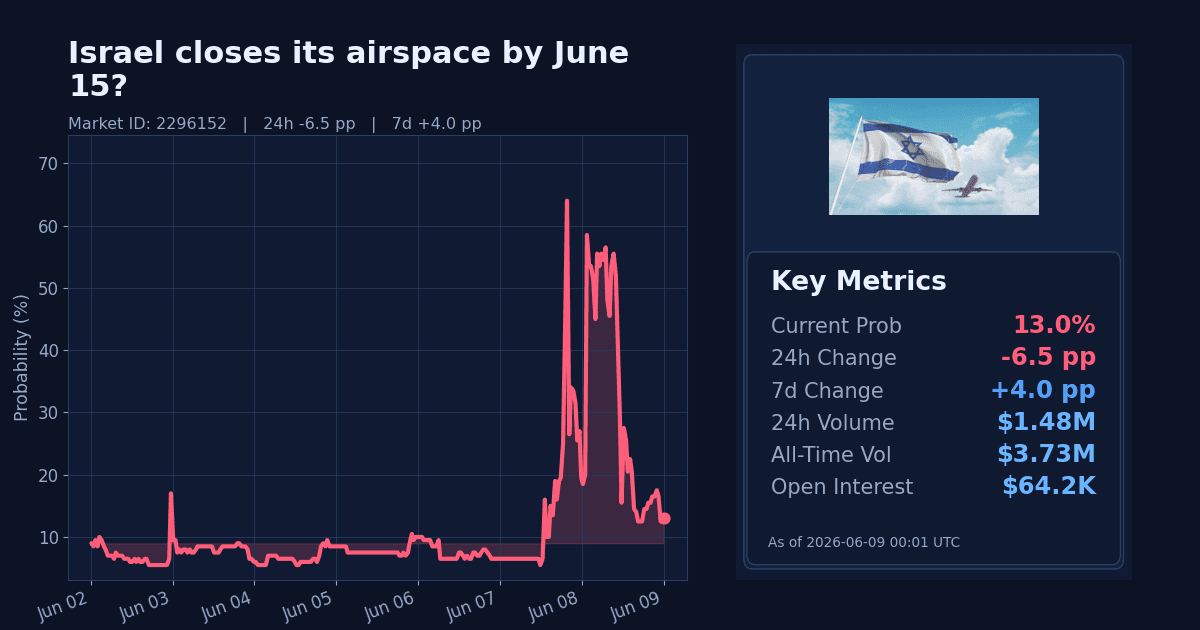
The Polymarket contract “Israel closes its airspace by June 15?” fell sharply over the past 24 hours, with traders marking down the likelihood of a broad, government-ordered suspension of civilian aviation before the June 15, 11:59 PM ET cutoff.
The contract requires a major, Israel-initiated closure that broadly halts commercial aviation across most Israeli civilian airspace. Airline- or third-country restrictions, localized disruptions, temporary ground stops, and weather-only closures do not qualify under the market’s rules.
Why It Likely Moved
- The repricing appears driven by reporting that, after a morning of sirens tied to missiles linked to Iran, daily life and events in Israel largely resumed, including in Tel Aviv, according to an AP dispatch on June 8 AP News.
- Markets reacted to the absence, in the supplied context, of any official Israeli government announcement signaling a broad, nationwide airspace closure by the deadline.
- The move also coincides with traders differentiating country-level risk: related markets price near-certainty for Iranian airspace closures while marking down Israel-specific closure risk, suggesting a separation between Iran-focused developments and Israeli aviation policy.
- In the broader backdrop, risk sentiment has turned more volatile — the VIX is up 17.9% over the past week — yet that macro shift did not translate into higher odds of an Israel-initiated closure in this contract.
How Strong the Move Is
On a one-day basis, the downtick screens as extreme relative to recent trading, consistent with a sharp reassessment rather than incremental drift. Over the past week, however, the market still sits above prior levels.
Specifically, the 24-hour change is negative with a 24h z-score of 28.0 (extreme down), while the 7-day change remains positive with a 7d z-score of 14.0 (extreme up). Netting both, this looks like a sharp pullback within an otherwise elevated week-long repricing.
Cross-Market Confirmation
- Iran closes its airspace by June 15? — trading at 99.9% (delta_24h: +0.2pp; delta_7d: +87.55pp). This diverges from Israel’s downtick, reinforcing country-specific differentiation.
- Iran closes its airspace by June 30? — at 99.8% (delta_24h: +0.2pp; delta_7d: +80.9pp). Directionally confirms near-certainty on Iran while not lifting Israel closure odds.
- Iran closes its airspace by June 8? — at 99.8% (delta_24h: +0.3pp). Also signals firmness on Iran-specific closure expectations, diverging from Israel’s repricing.
News & Real-World Context
- After sirens tied to missiles linked to Iran, Israelis “fell back into well-worn war routines,” with daily life, commerce, and events largely resuming, per a June 8 report from AP News. This on-the-ground normalization aligns with the market’s lower probability for a nationwide, government-ordered aviation halt.
- Broader markets reflected regional tension: oil prices “rose more than 4%” as Iran and Israel traded strikes, according to a June 8 roundup via Ground News. As of the latest macro print, Brent stands at $94.37/bbl (down 0.64% over 7 days), while equity volatility climbed, with the VIX up 17.88% over the week — indicating elevated global risk premia without a corresponding rise in Israel-closure odds.
- Government signals: the UK government published its statement to the extraordinary IAEA Board of Governors meeting on June 8 (delivered June 5), highlighting nuclear oversight amid heightened regional issues UK government. The European Commission on June 8 announced implementation steps for its Palestine facility to support MSMEs European Commission. The European Parliament also posted a June 8 written question on EU trade with Israeli settlements European Parliament. None of these items indicate an Israeli move toward a nationwide airspace shutdown.
Bottom Line
Traders marked down the probability of an Israel-initiated, broad airspace closure before June 15, aligning with reports of routine resuming inside Israel and no official closure notice in the supplied record. The move looks like a sharp, short-term pullback within a week that had previously priced higher regional risk — particularly around Iran — without translating into Israel-specific aviation restrictions.
Market Conditions at Time of Writing
- Current Probability (%): 13.0
- 24h Change (pp): -6.5
- 7d Change (pp): 4.0
- Volume (24h, $): 1,480,090.59
- Open Interest ($): 64,168.10
- Spread (pp): 1.0
- Z-score (24h): 28.0