What Moved the Market
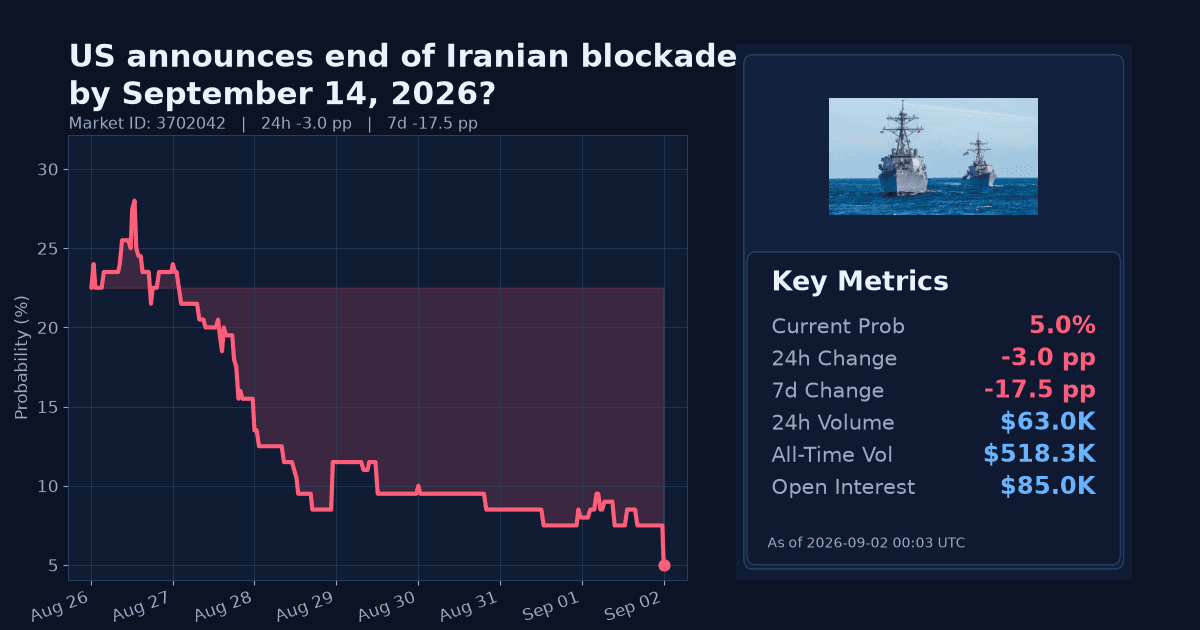
The Polymarket contract "US announces end of Iranian blockade by September 14, 2026?" repriced lower. Implied probability fell to 5.0%, down 3.0 percentage points over 24 hours and 17.5 percentage points over seven days.
The contract covers the window from August 18, 2026 to September 14, 2026, and resolves "Yes" only if an official US government statement clearly announces the end, termination, lifting, or suspension of the naval blockade on Iranian ships and customers within that period.
Why It Likely Moved
- The repricing appears driven by renewed US military action: the United States said on September 1 it is striking targets inside Iran after about a month without military action, according to AP News. This development points to escalation rather than an imminent easing that would include ending the blockade.
- Markets reacted to Iran’s conditional signaling: Iran’s president said on September 1 that Iran would return to a ceasefire agreement if the United States does, per AP News. The conditional framing does not indicate a current US decision to suspend the blockade.
- Policy backdrop from allied government statements remains confrontational: on August 31, the French Ministry for Europe and Foreign Affairs condemned Iranian strikes, underscoring an environment of ongoing hostilities.
- The repricing follows an energy-risk backdrop: Brent crude is at $95.22/bbl, up 7.5% over seven days, according to Yahoo Finance. Elevated oil prices are consistent with sustained geopolitical risk and do not signal an imminent de-escalation that would include lifting a blockade.
How Strong the Move Is
The 24-hour decline of 3.0 percentage points to 5.0% comes with an extreme 24h z-score of 12.0, indicating an outsized move versus recent trading history. Over seven days, the drop of 17.5 percentage points is also flagged as extreme (7d z-score ≈ 3.53).
Taken together, this is best characterized as a sharp downside spike rather than routine noise. With the contract ending on September 14, abrupt repricing near expiry is consistent with heightened sensitivity to new conflict signals.
Cross-Market Confirmation
- A shorter-window market (ends September 7) fell to 2.2% (24h: −1.65pp; 7d: −14.85pp), aligning directionally with the main contract’s decline.
- A longer-window variant (ends September 30) is at 20.0% (24h: −1.0pp; 7d: −21.0pp), confirming broader skepticism of a near-term US announcement ending the blockade despite the extra time.
- A related geopolitical outcome, “Kharg Island no longer under Iranian control by September 30,” is 2.3% (7d: +0.4pp). This slight uptick does not materially confirm or contradict the main move.
News & Real-World Context
- On September 1, the United States said it is hitting targets inside Iran as hostilities resumed following about a month without military action, according to AP News. This suggests an escalation phase rather than an imminent policy shift to lift the blockade.
- Also on September 1, Iran’s president stated that Iran would return to a ceasefire agreement if the United States does, per AP News. The conditional nature indicates no present mutual de-escalation in effect.
- On August 31, the French Ministry for Europe and Foreign Affairs publicly condemned Iranian strikes, reflecting continued regional tensions in official government communications.
- Among the provided government releases, there is no cited, qualifying US announcement ending or suspending the blockade as defined by the market’s resolution criteria.
Bottom Line
Pricing moved decisively lower on fresh indications of conflict and the absence of an official US de-escalation announcement. With less than two weeks to the September 14 cutoff, the move looks event-driven and time-sensitive rather than structural.
Market Conditions at Time of Writing
- Current Probability (%): 5.0
- 24h Change (pp): -3.0
- 7d Change (pp): -17.5
- Volume (24h, $): 63,014.22
- Open Interest ($): 85,048.03
- Spread (pp): 1.0
- Z-score (24h): 12.0