What Moved the Market
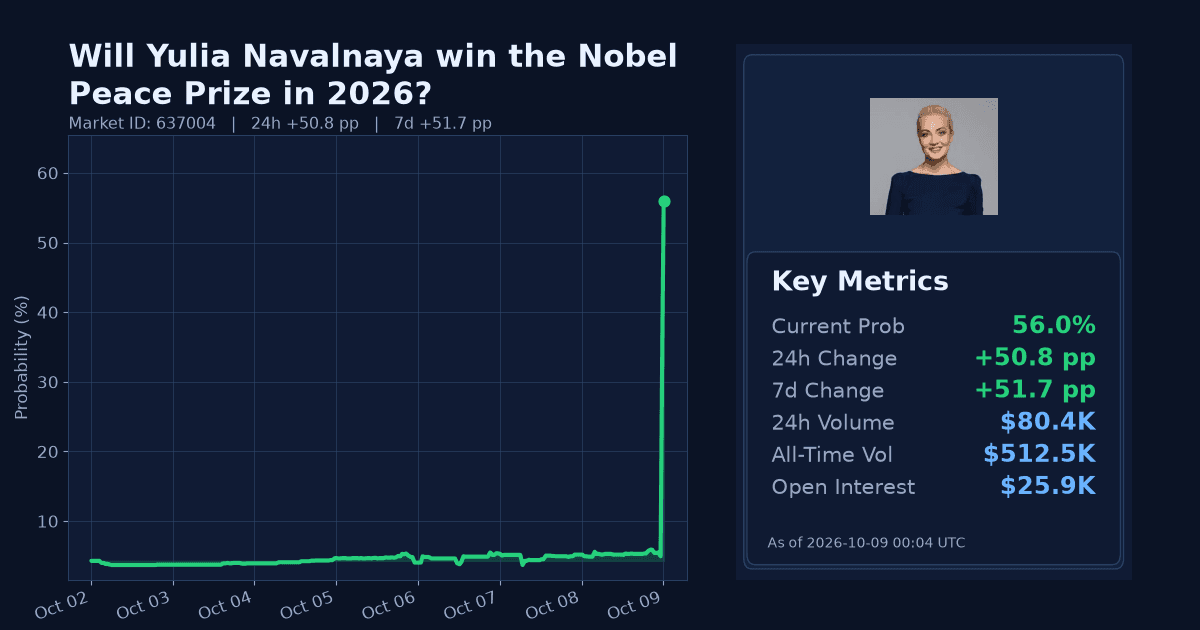
Yulia Navalnaya’s “Will Yulia Navalnaya win the Nobel Peace Prize in 2026?” contract jumped sharply, with the implied probability rising to 56%. Over the past 24 hours, the market moved up by 50.8 percentage points, with a 7-day increase of 51.7 percentage points.
The contract resolves on the 2026 Nobel Peace Prize announcement by the Norwegian Nobel Committee, within a window that runs from the market start date (October 16, 2025) through April 1, 2027; if no official announcement is made by March 31, 2027, it resolves to “Other,” per market rules.
Why It Likely Moved
- The repricing appears driven by official actions spotlighting Russia’s war and governance context: the UK government announced 38 new Russia-related sanctions on October 8, 2026, targeting oil, finance, and supply chains fueling the war effort, according to the UK government.
- Markets reacted to the European Parliament’s October 8, 2026 resolution condemning Russian State Duma elections as a “complete sham,” a move the European Parliament framed within ongoing aggression against Ukraine.
- Additional news flow underscores continuing repression of Navalny-linked supporters: a Russian liberal politician was sentenced to four years over a donation to a Navalny-associated group, per Ground News on October 8, 2026.
- The move looks idiosyncratic rather than macro-driven: the VIX sits at 15.41 (down ~6% over 7 days) and the S&P 500 is up ~1.29% over 7 days, indicating calm broader risk conditions.
How Strong the Move Is
This is an extreme repricing. The 24-hour z-score is 202.0 and the 7-day z-score is 208.4, both characterized as “extreme” relative to the market’s recent trading history. The speed and scale point to a sharp, event-linked spike rather than gradual accumulation.
With a 24h change of +50.8pp and a 7d change of +51.7pp, this qualifies as a sudden spike rather than trend continuation. Liquidity conditions (tight 1.7pp spread) and elevated 24h volume ($80,377.78) indicate strong engagement around this repricing.
Cross-Market Confirmation
- Alternative 2026 Nobel Peace Prize candidates show declines: “Sudan’s Emergency Response Rooms” fell 11.5pp over 24h (to 4.6%), aligning with a rotation toward Navalnaya.
- Another competitor, “Mykola Kuleba,” is down 3.0pp over 24h (to 6.0%), further confirming concentration into this contract.
- Broader Russia-political risk markets show minimal movement: “Putin out as President of Russia by Dec 31, 2026?” is largely flat (+0.05pp over 24h; +0.45pp over 7d), suggesting the Navalnaya move is not mirrored by regime-change pricing.
News & Real-World Context
- On October 8, 2026, the UK announced 38 new designations targeting Russian oil entities, shadow fleet tankers, and suppliers of critical military goods, aiming to “hit the money, oil and supply chains fuelling Russia’s war,” per the UK government.
- Also on October 8, 2026, the European Parliament adopted a resolution condemning Russian State Duma elections as a “complete sham,” set against the backdrop of the war in Ukraine. A same-day EP press note underscores the institution’s broader foreign-affairs stance (European Parliament, Oct 8, 2026).
- Domestic repression linked to the Navalny movement continued: a Russian liberal politician was jailed for four years for donating to a Navalny-associated organization, reported October 8, 2026 by Ground News.
Bottom Line
The market’s sharp upward repricing in Yulia Navalnaya’s 2026 Nobel Peace Prize odds aligns with a cluster of official EU/UK actions and reporting on continued repression of Navalny-linked supporters. Given the extreme z-scores and concentrated cross-market rotation, this looks like a short-term, event-driven spike rather than a structural revaluation.
Market Conditions at Time of Writing
- Current Probability: 56.0%
- 24h Change: +50.8pp
- 7d Change: +51.7pp
- Volume (24h, $): 80,377.78
- Open Interest ($): 25,857.30
- Spread (pp): 1.7
- Z-score (24h): 202.0 (extreme)