What Moved the Market
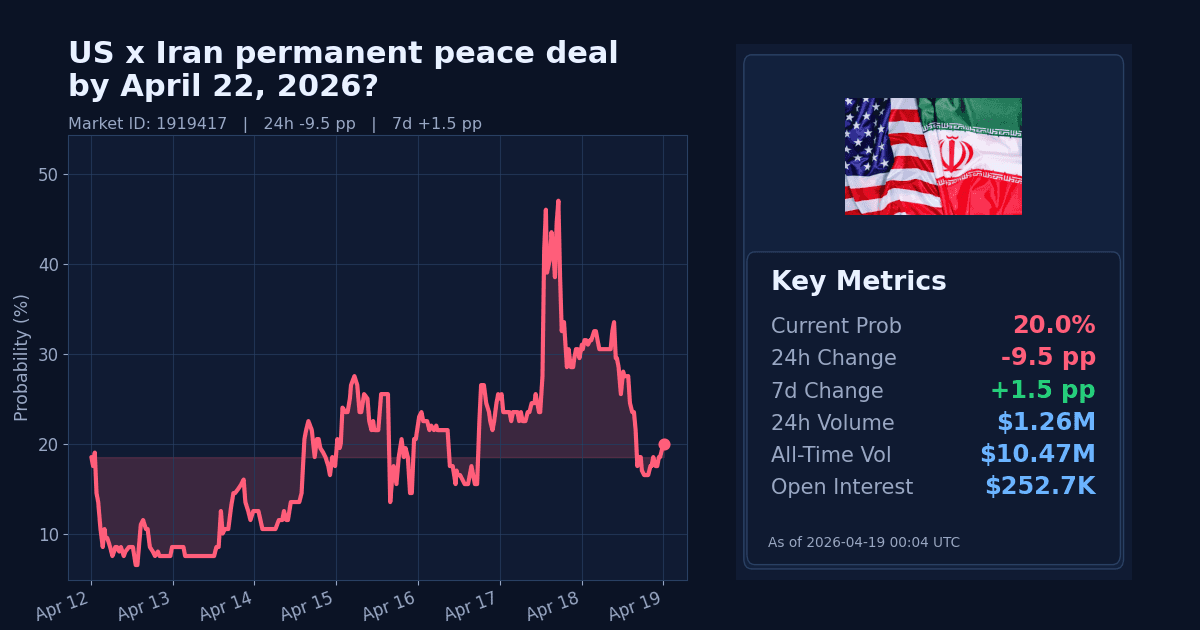
The Polymarket contract “US x Iran permanent peace deal by April 22, 2026?” dropped sharply over the last 24 hours, sliding 9.5 percentage points to 20.0% as of April 19, 2026. The move comes three days before the market’s end date (April 22, 2026), narrowing the window for any qualifying announcement.
Over the past week, the contract is still up 1.5 points, indicating earlier optimism that has now been partly unwound.
Why It Likely Moved
- The repricing appears driven by fresh escalation signals in the Strait of Hormuz: Axios reported on April 18 that Iran closed the strait and fired on multiple commercial tankers, disrupting a key transit chokepoint (Axios).
- Markets reacted to US decision-making urgency: the White House convened a situation room meeting amid the renewed Hormuz crisis, per Axios on April 18, underscoring elevated risk management rather than near-term de-escalation (Axios).
- The repricing follows official US signaling: on April 16, the US Department of War urged Iran to “choose wisely” during a ceasefire and blockade period, framing the moment as a test for good-faith steps toward a deal but not indicating any agreement was imminent (the US government, Apr 16, 2026).
- Broader Western statements increased diplomatic pressure: the UK condemned attacks on shipping at the UN on April 16 (the UK government) and welcomed a Lebanon ceasefire on April 17 (the UK government), while the European Parliament flagged Hormuz-related international law and energy concerns in a priority written question on April 16 (the European Parliament).
- Additional media context emphasized uncertainty: NPR on April 18 highlighted persistent insecurity around Hormuz and noted a statement by Donald Trump that a blockade on Iranian ports would remain in place, alongside expert commentary on the complexity of securing quick deals with Iran (NPR; NPR).
How Strong the Move Is
The 24-hour decline of 9.5 percentage points registers an extreme move by the market’s own history, with a 24h z-score of 48.0. This classifies as a sharp, event-driven spike lower.
Despite the steep daily drop, the 7-day change remains slightly positive (+1.5pp) with a “normal” 7d z-score. That pattern points to a reversal of recent optimism rather than a steady trend deterioration.
Cross-Market Confirmation
- US–Iran peace by April 30, 2026: down 4.0pp on the day to 40.0%, but up 12.0pp over 7 days — confirming today’s downside while echoing last week’s optimism.
- US–Iran peace by May 31, 2026: down 3.5pp on the day to 59.0%, up 16.0pp over 7 days — directionally aligned with today’s selloff, with longer-dated markets still relatively more constructive.
- Israel–Hezbollah ceasefire by April 18, 2026: essentially unchanged (+0.1pp to 99.9%), a divergence that reflects stabilization on a separate front while US–Iran probabilities fell.
News & Real-World Context
- On April 18, Axios reported Iran closed the Strait of Hormuz and fired on tankers, prompting concern over maritime security and potential escalation (Axios). The same day, Axios noted a White House situation room meeting on Iran and Hormuz (Axios). NPR highlighted persistent uncertainty in the strait and referenced a statement by Donald Trump that a blockade on Iranian ports would remain in place (NPR).
- Official statements reinforced the risk posture: on April 16, the US government urged Iran to act “wisely” amid a ceasefire and blockade context (the US government); the UK condemned shipping attacks at the UN the same day (the UK government), and welcomed a Lebanon ceasefire on April 17 (the UK government). The European Parliament raised Hormuz-related legal and energy issues in a priority written question on April 16 (the European Parliament).
- Macro backdrop: despite the shipping headlines, WTI crude settled at $82.59/bbl as of April 17, down 14.48% week-over-week, while the VIX fell 9.10% over the same period — mixed macro confirmation that broader markets were not pricing an acute, generalized risk surge as of those timestamps.
Bottom Line
This is a late-window, event-driven selloff: reports of Hormuz clashes and firm official messaging reduced the already narrow odds of a qualifying “permanent peace” announcement by April 22. The move looks sharp and reactive rather than a multi-week trend shift.
With only days left in the contract window, absent clear, reciprocal government confirmations of a deal, pricing now reflects high skepticism of a last-minute breakthrough.
Market Conditions at Time of Writing
- Current Probability: 20.0%
- 24h Change: -9.5pp
- 7d Change: +1.5pp
- Volume (24h): $1,264,770.48
- Open Interest: $252,725.66
- Spread: 1.0pp
- Z-score (24h): 48.0