What Moved the Market
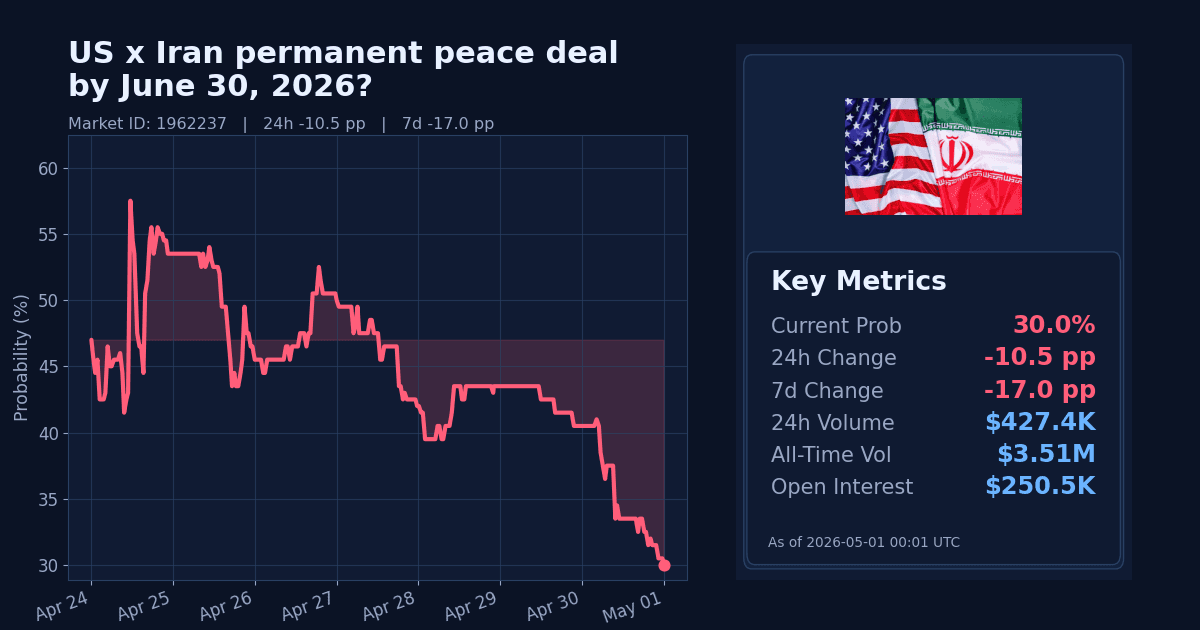
The Polymarket contract asking whether the United States and Iran will agree a “permanent peace deal” by 11:59 PM ET on June 30, 2026 fell 10.5 percentage points over the last 24 hours to 30%. The 7‑day move is -17pp. The bid–ask spread remains tight at 2pp, with $427,434 traded in the past day and $250,502 in open interest.
Launched on April 12, 2026, the market resolves “Yes” only if both governments sign/adopt a written agreement or publicly and clearly confirm a definitive, lasting end to military hostilities. Temporary arrangements or non‑definitive statements do not qualify.
Why It Likely Moved
- The repricing appears driven by public signals from the U.S. government that a lasting agreement faces substantial obstacles. On April 27, Secretary of State Marco Rubio said the current ceasefire is temporary “unless the Iranians are willing to make a good‑faith deal,” identified the nuclear question as the core issue, and described internal Iranian dysfunction complicating negotiations (the U.S. State Department, 2026-04-27).
- Markets likely reacted to Iran’s hardline posture. On April 30, Iran’s supreme leader stated Tehran will protect its “nuclear and missile capabilities,” signaling resistance to concessions central to a “permanent” de‑escalation (AP News, 2026-04-30).
- The downside repricing follows reports of fresh U.S. military planning. CENTCOM commanders were scheduled to brief the President on new Iran options (Axios, 2026-04-30), and separate reporting said an Iran blockade extension was under consideration, reinforcing a coercive posture (Ground News, 2026-04-30).
- Energy markets reflected elevated geopolitical risk. Brent crude surged above $120 intraday on Iran war worries (AP News, 2026-04-30). As a macro cross‑check, Brent stood at $111.66/bbl, up 6.27% over 7 days as of April 30 (Yahoo Finance), consistent with tighter supply/risk premia rather than imminent durable peace.
How Strong the Move Is
By statistical measures, the 24‑hour move is extreme: a z‑score of 38.0 places the drop well outside the market’s recent trading distribution. The 7‑day z‑score of 4.57 is also categorized as extreme.
Taken together with a -17pp week‑over‑week change and high 24h turnover, this looks like an extreme downside spike that extends a week‑long drift lower, rather than routine noise.
Cross-Market Confirmation
- US x Iran permanent peace deal by May 31, 2026: down 6.0pp (24h) and 12.0pp (7d) to 19%. This corroborates broader de‑risking on near‑term peace timelines.
- US x Iran diplomatic meeting by May 15, 2026: down 2.5pp (24h) and 29.0pp (7d) to 24%. Softer meeting odds align with reduced expectations for rapid diplomatic progress.
- US x Iran permanent peace deal by May 15, 2026: at 7.0% (no reported deltas). While deltas are unavailable, the low level is directionally consistent with the main move’s skepticism on imminence.
News & Real-World Context
- The U.S. government framed the ceasefire as temporary and highlighted unresolved nuclear and internal Iranian issues impeding a deal, according to an April 27 interview by Secretary of State Marco Rubio published by the U.S. State Department (2026-04-27).
- Iran’s supreme leader said on April 30 that Tehran will protect its “nuclear and missile capabilities,” signaling a firm stance amid tensions (AP News, 2026-04-30).
- CENTCOM leaders were set to brief the President on new Iran military options on April 30 (Axios, 2026-04-30). Separate reporting indicated the White House is considering extending an Iran blockade, pushing oil to its highest since 2022 (Ground News, 2026-04-30).
- Brent crude spiked above $120 intraday on Iran war worries (AP News, 2026-04-30). Regional financial stress signals included the UAE seeking a U.S. dollar swap line “with the Iran War underway” (NPR, 2026-04-30).
Bottom Line
Pricing now reflects a materially lower probability that Washington and Tehran will reach an explicit, durable end to hostilities by June 30, 2026. Government statements stressing conditional, temporary ceasefire terms and reports of renewed military planning are inconsistent with a near‑term “permanent peace” announcement. The move looks structural over the short run, though new official signals would be required to reverse the trend.
Market Conditions at Time of Writing
- Current Probability: 30.0%
- 24h Change: -10.5pp
- 7d Change: -17.0pp
- Volume (24h, $): 427,433.73
- Open Interest ($): 250,502.24
- Spread (pp): 2.0
- Z-score (24h): 38.0