What Moved the Market
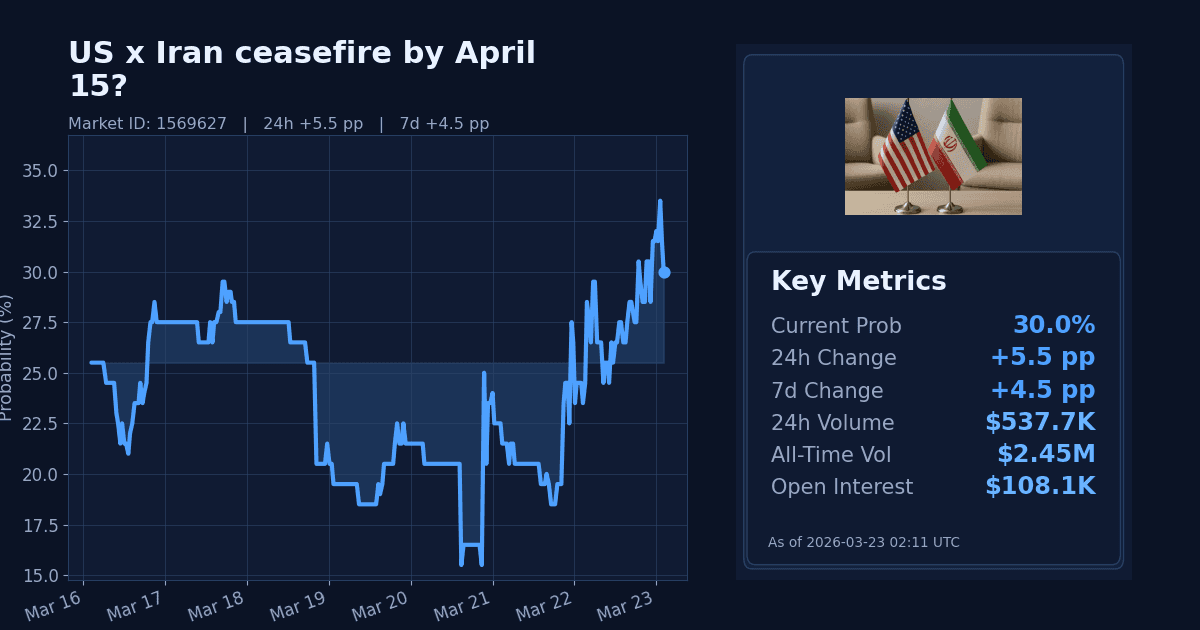
The Polymarket contract on whether the United States and Iran will announce an official ceasefire by April 15, 11:59 PM ET, climbed to a 30% implied probability. The market’s specification requires public confirmation from both governments of a mutually agreed halt in military hostilities within the contract window (market started Mar 12, 2026 and ends Apr 15, 2026).
Over the past 24 hours, the contract rose by 5.5 percentage points, with a 24h z-score flagged as “extreme.” Seven-day change is +4.5pp, while recent trading shows a tight 1pp spread and active flow.
Why It Likely Moved
- Repricing appears driven by trader reaction to high-salience escalation headlines, including Iran’s missile strikes on two Israeli cities and a U.S. presidential threat window tied to the Strait of Hormuz, which can raise the perceived need for a formal off-ramp within the contract’s timeline.
- Markets reacted to external pressure signals, notably Switzerland halting new arms exports to the U.S. over the Iran war, which could be read as nudging toward negotiations or a publicly framed pause.
- The shift seems informed by timeline dynamics across related markets: lower odds for a ceasefire by March 31 suggest probability being pushed into the later Apr 15 window.
- The move unfolds against elevated energy risk: WTI crude near $98.71, up 48.68% over 30 days, underscores the economic backdrop that may factor into expectations for de-escalation steps.
How Strong the Move Is
The 24-hour increase of 5.5pp comes with an “extreme” 24h z-score, indicating an unusually sharp daily repricing versus recent trading history. Liquidity looks solid with ~$538k traded in 24h and a 1pp spread.
By contrast, the 7-day z-score reads as normal/flat and the 7d change is modest (+4.5pp), which frames the move as a single-day spike rather than a fully established trend. Overall, this looks like a headline-driven pop more than a structural re-rate.
Cross-Market Confirmation
- US x Iran ceasefire by March 31 sits much lower at 12%, a partial confirmation that traders see any formal halt as more plausible on the later Apr 15 timeline rather than imminently.
- “US forces enter Iran by March 31?” at 22% signals ongoing escalation risk, a divergence from higher ceasefire odds and a reminder of two-way event risk.
- “Will the Iranian regime fall by June 30?” at 25% reflects persistently elevated instability perceptions, offering neutral-to-divergent context for a near-term ceasefire bet.
- The March 31 ceasefire market’s higher 24h volume (
$2.12m) versus this market ($0.54m) suggests attention remains concentrated on nearer deadlines even as Apr 15 odds reprice upward.
News & Real-World Context
- Iran launched missiles at two southern Israeli cities near a key nuclear research area; the U.S. President threatened to “obliterate” Iranian power plants and gave Iran 48 hours to reopen the Strait of Hormuz.
- Switzerland moved to halt new arms exports to the U.S. over the Iran war, an external pressure signal that adds to the diplomatic backdrop.
- Russia publicly reaffirmed its friendship with Iran, highlighting a complex geopolitical alignment around any de-escalation effort.
Bottom Line
The Apr 15 US–Iran ceasefire market saw an extreme 24h jump to 30%, likely reflecting positioning amid intense escalation headlines and visible external pressure. Cross-market signals are mixed, and energy prices remain elevated, suggesting this is a short-term, headline-driven repricing rather than a confirmed structural shift.
Market Conditions at Time of Writing
- Current Probability: 30%
- 24h Change: +5.5pp
- 7d Change: +4.5pp
- Volume (24h): $537,682.99
- Open Interest: $108,068.23
- Spread: 1.0pp
- Z-score (24h): 28.0 (extreme up)
- Z-score (7d): 0.0 (normal/flat)