The Rise of AI in Politics
Artificial intelligence is no longer a peripheral factor in politics. It is becoming part of the political arena itself—shaping how information is produced, how narratives spread, how trust is challenged, and how influence is exercised. For a platform like Global Political Spotlight (GPS), this is not just a technology story. It is a geopolitical and democratic one.
The central issue is not whether AI is “good” or “bad” for politics. The real issue is that AI is changing the structure of political communication faster than institutions can adapt. That creates both opportunity and risk. On one hand, AI can expand access to information, lower the cost of communication, and help political actors engage more efficiently. On the other, it can also enable synthetic propaganda, manipulation at scale, and new forms of censorship. The political significance of AI lies in that tension.
A New Political Information Environment
Politics has always depended on persuasion. What AI changes is the speed, scale, and realism with which persuasion can now be manufactured.
Generative AI allows text, audio, images, and video to be produced at near-zero marginal cost. That means content no longer needs to be authentic to feel persuasive. As the Brookings Institution notes, generative AI can amplify existing threats to democratic processes by making misleading content cheaper to create, easier to adapt, and harder to counter at scale.
From a GPS perspective, this matters because politics depends on shared reference points. Once the information ecosystem becomes saturated with synthetic media, the real challenge is not only identifying falsehoods—it is preserving confidence in what remains real. In that sense, AI does not merely introduce “more misinformation.” It puts pressure on the basic conditions required for informed public debate.
Deepfakes and the Erosion of Trust
Deepfakes are the clearest symbol of this new era. A realistic fake video or voice clip can be released at a strategically chosen moment, forcing a public figure to react before verification catches up. Even when the deception is later exposed, the political effect may already have been achieved.
Yet the deeper danger is broader than individual fake clips. AI-generated content weakens the credibility of evidence itself. The Brookings Institution highlights the growing importance of the so-called “liar’s dividend”: once deepfakes are widely known, politicians and public figures can dismiss genuine evidence as fabricated. In other words, AI can help create fake scandals—but it can also help real scandals be denied.
That makes the issue especially serious. A healthy political system requires accountability, and accountability requires that evidence can still carry weight. If every recording can be doubted and every denial can be justified by invoking AI, the cost is not just confusion—it is institutional weakening.
At the same time, an open-minded analysis should avoid overstating the technology. Not every viral clip is a deepfake, and not every deepfake succeeds. But even failed attempts can shape public expectations and increase ambient distrust. That alone is politically consequential.
LLM Bots and Agenda-Driven Influence
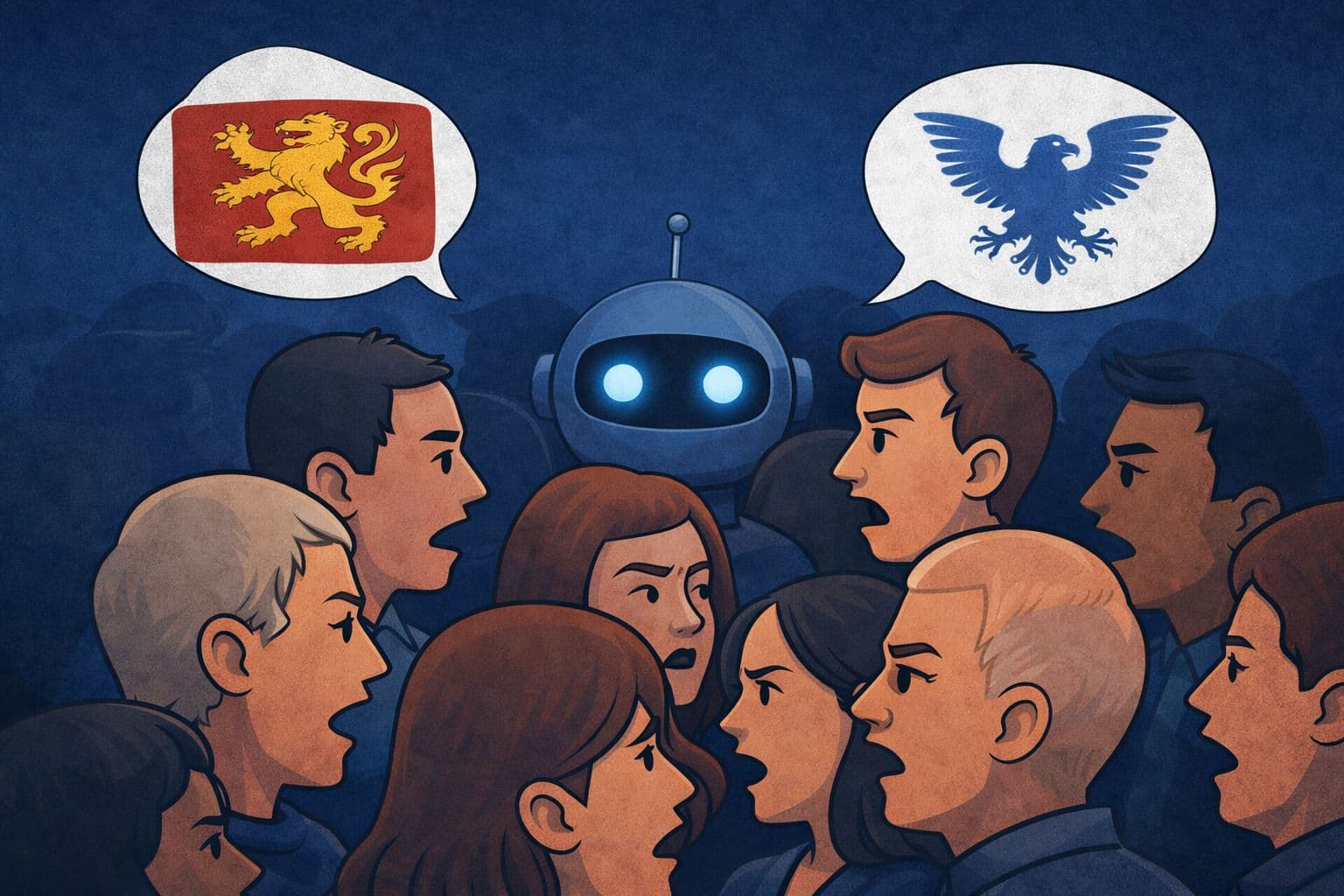
Another major shift is the rise of LLM-driven influence operations. These are not limited to obvious spam bots. They can take the form of accounts that comment on political videos, reply to posts, generate persuasive takes, imitate grassroots voices, or flood discussions with content that appears organic.
This matters because perception often drives politics as much as facts do. If AI systems can create the appearance of widespread support, outrage, or consensus, they can distort how people interpret the public mood. The Brookings Institution warns that generative AI can help manufacture the perception of consensus, deepen division, and undermine trust in democratic institutions.
There is also real-world evidence that such tools are already being tested. OpenAI reported in 2024 that it had disrupted multiple covert influence operations attempting to use its models to generate comments, articles, and fake personas tied to political narratives. Importantly, OpenAI also said these operations did not appear to achieve major reach through its services. That is an important reminder: the threat is real, but its impact is still developing.
The same balanced conclusion appears in Freedom House, which found that generative AI–assisted disinformation campaigns were emerging in elections, including in Rwanda, but had not yet clearly transformed electoral outcomes in a decisive way. That nuance matters. AI is not replacing traditional propaganda, media ecosystems, or political institutions overnight. What it is doing is lowering the cost of narrative manipulation and increasing the ease with which agenda-driven content can be deployed.
For GPS, that is the key analytical point: AI may not need to fully control discourse to reshape it. It only needs to make distortion cheaper, faster, and more scalable.
The Politics Inside the Models Themselves
One of the most underappreciated developments is that AI models are not neutral intermediaries. They are designed, trained, and filtered. That means they can carry political assumptions, ideological preferences, and explicit censorship rules.
This becomes especially visible when AI systems are developed in tightly controlled information environments. Reuters reported that U.S. officials testing Chinese AI systems, including DeepSeek’s R1, found that they were significantly more likely than U.S. models to align answers with Beijing’s official positions on politically sensitive issues. Reuters also noted that DeepSeek frequently used boilerplate language praising “stability and social harmony” when asked about issues such as Tiananmen Square.
That is not a minor technical quirk. It suggests that AI systems can become extensions of state information control. If a model systematically avoids or reframes politically sensitive facts, it does not simply “fail to answer” a question—it participates in shaping political reality for its users.
At the same time, this should not be reduced to a purely China-specific issue. As Reuters also notes, ideological steering and concerns about chatbot bias are broader global issues. All major AI systems are shaped by the incentives, rules, and institutional contexts of their creators. That means future politics may increasingly be influenced not just by what citizens say to each other, but by what the systems between them allow, discourage, or silence.
This is where AI becomes a geopolitical issue in the strict sense: model behavior itself can reflect national priorities, regulatory pressures, and ideological boundaries.
Regulation Is Moving, but Slowly
Governments have started to respond, though the pace of policy remains slower than the pace of deployment.
In the United States, the Federal Communications Commission ruled in February 2024 that AI-generated voices in robocalls are illegal under existing law. The FCC explicitly linked this move to voter deception and fraudulent impersonation, including fake Biden-voice robocalls during the New Hampshire primary.
In Europe, the European Commission has moved in a similar direction through transparency requirements tied to the AI Act, including obligations around disclosure of AI-generated or manipulated content such as deepfakes.
These are meaningful steps, but they should be viewed realistically. Transparency rules, labeling standards, and robocall bans can reduce some abuse. They do not eliminate the wider structural shift: politics is entering a world where synthetic content can be produced globally, remixed instantly, and circulated across multiple platforms before institutions can meaningfully react.
The likely long-term outcome is not a fully regulated and stable system, but a constant race between manipulation, detection, platform policy, and public adaptation.
How Politics Is Likely to Change
Looking ahead, AI is likely to change politics in several lasting ways.
1. Verification will become a central political function
As synthetic content becomes more common, the ability to verify authenticity will become more valuable. Journalists, institutions, campaigns, and platforms will increasingly compete not just over narrative, but over credibility. In a world of deepfakes and synthetic text, trust itself becomes a strategic asset.
2. Political messaging will become more automated
Campaigns and advocacy groups will use AI to scale messaging, localize content, test narratives, and respond faster. Some of this will be legitimate and efficient. Some of it will blur into manipulation. The dividing line between normal digital campaigning and industrialized narrative engineering may become harder to draw.
3. Model governance will become a political battleground
As AI assistants become embedded in search, education, and communication, questions about moderation, bias, censorship, and ideological framing will become core political questions. The debate will no longer be only about political speech on platforms—it will also be about the values embedded into the models that mediate political knowledge.
4. Propaganda will become more personalized and less visible
Traditional propaganda was often obvious. AI-enabled persuasion can be quieter, more conversational, and tailored to specific communities or emotional triggers. That makes it harder to identify and potentially more effective over time.
5. Democratic resilience will depend more on public literacy
Societies may not be able to eliminate synthetic influence, but they can become better at recognizing its patterns. Media literacy, institutional trust, source verification, and transparency tools will all become more important. The long-term contest may not be over who has the most content, but over who can still produce content that people genuinely trust.
Conclusion
The rise of AI in politics is not a distant scenario. It is already underway. Deepfakes are challenging the credibility of evidence. LLM-driven bots are lowering the cost of agenda-driven influence. AI models themselves are becoming political actors in a broader sense, especially when their outputs reflect censorship, bias, or state priorities. And regulators are only beginning to respond.
For GPS, the most important point is this: AI is not simply adding another tool to politics. It is changing the structure of political communication itself. That does not mean the future is predetermined, nor does it mean every new AI application will be destructive. But it does mean that politics is entering a more synthetic, more contested, and more strategically complex information age.
The real test will not be whether AI enters politics—it already has. The real test is whether democratic systems, institutions, and citizens can adapt without losing the trust, accountability, and open debate that politics ultimately depends on.