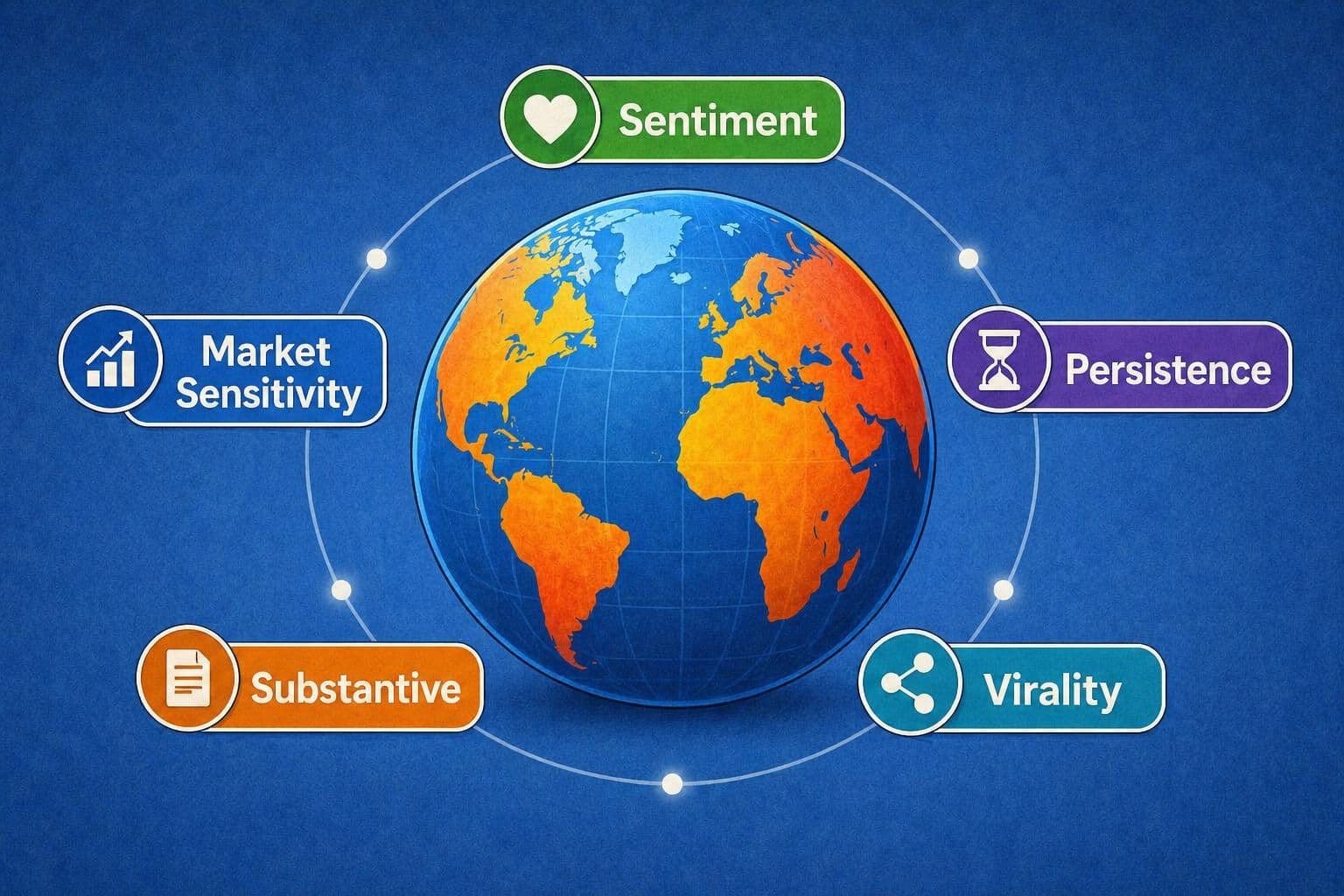
What GPS Metrics Are and Why We Built Them
A Better Way to Read Through the Noise
At Global Political Spotlight, we built GPS metrics because modern news is full of motion, but not all motion carries the same weight.
Some developments are historically important but spread quietly. Others dominate feeds for a day and then disappear. Some matter mainly for investors. Others matter because they change the welfare of people on the ground. In a crowded news environment, those differences are easy to lose.
That is where GPS metrics come in. They are designed to help readers move beyond the headline and ask a more useful question: what kind of signal does this development actually carry?
GPS was built to make fragmented geopolitical information easier to compare, interpret, and revisit over time. We firmly believe GPS metrics is the clearest tools do to exactly that.
What GPS Metrics Actually Measure
Each GPS metric is scored on a 0.00 to 1.00 scale.
A score near 0.00 indicates very low signal for that metric. A score near 0.50 indicates a mixed or middling case. A score near 1.00 indicates a very strong signal.
The goal is not to reduce geopolitical developments to a single number. It is to make different kinds of importance easier to compare across stories, sectors, and time.
Each metric focuses on a different dimension of relevance:
- Substantive measures how materially important a development is for policy, state action, or geopolitical consequences.
- Sentiment measures whether the underlying development is positive, negative, or neutral for the welfare of affected people, communities, or living beings.
- Virality measures how likely a development is to trigger broad sharing and public reaction beyond its core audience.
- Policy Impact measures the degree of real institutional change, separating rhetoric from binding decisions and implementation.
- Persistence measures how long a development is likely to keep shaping decisions, constraints, or narratives.
- Market Sensitivity measures how likely a development is to matter for tradable markets through a concrete transmission channel.
Taken together, these metrics help distinguish between attention, consequence, durability, action, welfare, and financial relevance.
Why We Created Them
We introduced GPS metrics because information overload is not only a volume problem. It is also a judgment problem.
The Reuters Institute Digital News Report 2024 found that news avoidance remains high across many countries, with many readers saying the news feels exhausting, repetitive, or overwhelming, according to the Reuters Institute summary and Press Gazette’s reporting on the findings.
In our view, one reason readers disengage is that too much coverage is presented in a flat stream. A market-moving central bank decision, a symbolic diplomatic gesture, a violent escalation, and a viral political controversy can all appear side by side with very little help in understanding how they differ.
GPS metrics are our response to that flatness.
How to Use GPS Metrics When Reading GPS Briefs
The metrics are not meant to replace reading. They are meant to improve it.
They help readers scan a brief and immediately understand what sort of event they are looking at.
A development with high Substantive and high Policy Impact scores is usually worth reading closely even if it is not especially viral. A story with high Virality but low Persistence may explain the public mood without reshaping the deeper geopolitical picture. A high Market Sensitivity score can signal immediate relevance for investors, even when the welfare implications are limited or indirect. A high Persistence score suggests that a story is not just a moment, but part of a structure that may still matter months from now.
In that sense, GPS metrics help readers prioritize not only by attention, but by analytical value.
What Value They Add
This is where GPS differs from a more conventional news feed.
We are not only trying to summarize what happened. We are trying to clarify what kind of development it was.
That matters because many stories look similar at headline level but become very different once you ask sharper questions. A minister’s speech may be highly viral but have little policy impact. A quiet regulatory decision may barely spread online but carry lasting market consequences. A humanitarian development may have low virality but very high welfare significance.
GPS metrics make those distinctions easier to see.
They create a more disciplined way to read the morning news: less reactive, more comparative, and more explicit about the nature of importance.
Why This Opens the Door to Better Information Analysis
We see GPS metrics as part of a broader shift in how news can be read in the future.
As more content competes for attention by maximizing speed, outrage, or emotional reaction, there is increasing value in systems that restore structure. Metrics like these do not eliminate complexity. They help organize it.
For readers, that means a better chance of cutting through noise. For analysts, it opens the door to more consistent comparison across topics and time. For the broader information environment, it suggests a model where reading news becomes less about consuming a stream and more about identifying signal.
That is the deeper purpose of GPS metrics.
They were created to help readers understand not just what happened, but how to think about what happened.