What Moved the Market
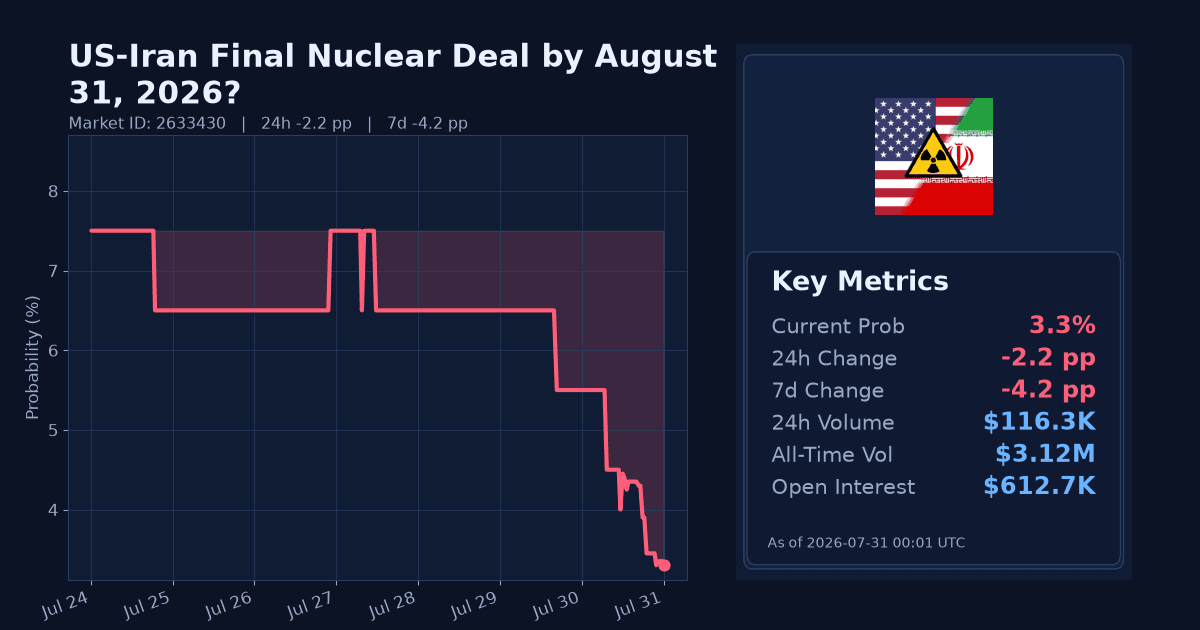
The Polymarket contract on whether the United States and Iran will mutually sign or formally adopt a “final deal” by August 31, 2026 dropped 2.2 percentage points over the last 24 hours to 3.3%. Over the past week, pricing is down 4.2 percentage points.
The contract requires a qualifying written instrument—identified as the final deal envisioned by the June 14, 2026 understanding—that imposes at least one specific, testable limit on Iran’s nuclear program, signed or formally adopted by both sides by 11:59 PM ET on August 31, 2026.
Why It Likely Moved
- The repricing appears driven by fresh reporting of widening Iran-related conflict across the region, including cross-border strikes and maritime disruption that complicate diplomacy, according to AP News on July 30, 2026 (AP News).
- Markets reacted to satellite-verified damage from Iranian and Iran-aligned Houthi attacks on AWS data centers and a Saudi refinery—signals of escalation that typically reduce near-term odds of concluding complex agreements (Ars Technica, Jul 30, 2026).
- Repricing follows additional reports tying cyber intrusions in Minnesota water utilities to Tehran-linked actors, reinforcing a risk environment inconsistent with final-deal closure in the short window remaining (WIRED, Jul 30, 2026).
- The absence of new official U.S. or Iranian announcements advancing a final agreement contrasts with unrelated government communications, such as the U.S. State Department’s July 29 fact sheet on Peru relations (U.S. State Department, Jul 29, 2026) and a French notice on civil nuclear cooperation with Kazakhstan (French MFA, Jul 30, 2026).
How Strong the Move Is
The 24-hour decline of 2.2 percentage points is classified as extreme by the market’s own z-score (z=10.8), indicating an outsized shift relative to recent trading. The 7-day fall of 4.2 percentage points is also extreme (z=16.6), suggesting sustained downside pressure rather than a brief dislocation.
With the contract window closing on August 31, 2026, the persistence of extreme downside z-scores points to a significant repricing of near-term deal-closure odds rather than normal volatility.
Cross-Market Confirmation
- The parallel market for an earlier deadline—“US-Iran Final Nuclear Deal by August 18, 2026?”—fell 2.25pp over 24h and 3.2pp over 7d, confirming broader skepticism on imminent signature/adoption.
- “Will the U.S. invade Iran before 2027?” rose 1.0pp over 24h but is down 6.0pp over 7d, offering mixed confirmation: a short-term uptick aligns with conflict headlines, while the weekly move does not.
- The “Kharg Island no longer under Iranian control by August 31?” market declined 0.8pp over 24h and 3.6pp over 7d, a divergence from an acute-escalation narrative and not supportive of a generalized regional risk premium.
- Macro confirmation is limited: WTI crude oil stands at $83.99/bbl and fell 8.9% over 7 days, while the VIX declined 8.6% over the same period—neither indicating a broad risk-off or energy-supply shock (Yahoo Finance, as of July 30, 2026).
News & Real-World Context
- AP News reported on July 30, 2026 that new fronts appear to be opening across the Middle East, citing actions by Iran, U.S. responses, and Iran-aligned proxies as drivers complicating diplomacy and widening conflict (AP News).
- On July 30, 2026, Ars Technica highlighted satellite imagery showing burn scars and active fires at AWS data centers in the UAE and Bahrain and a Saudi refinery following missile and drone attacks attributed to Iran and the Houthis, as part of a broader exchange of strikes involving the U.S. and Gulf states (Ars Technica).
- Also on July 30, WIRED reported a WaterISAC memo linking dozens of cyberattacks on Minnesota water utilities to Tehran-tied actors, adding to the picture of multifaceted confrontation (WIRED).
- No new official U.S. or Iranian government statements advancing a final agreement were identified in the supplied context. Available government releases addressed other topics, including a U.S. State Department fact sheet on U.S.–Peru relations (published July 29, 2026) (U.S. State Department) and a French Ministry for Europe and Foreign Affairs note on a civil nuclear committee meeting with Kazakhstan (published July 30, 2026) (French MFA).
Bottom Line
The market’s sharp, extreme-score decline reflects conflict-focused headlines and a lack of visible official steps toward a mutually signed or formally adopted final deal within the remaining window. Cross-market and macro signals are mixed, with related Polymarkets confirming lower odds while broader risk and oil benchmarks do not indicate a systemic shock. Overall, this looks like a strong, near-term repricing lower as the August 31, 2026 deadline approaches.
Market Conditions at Time of Writing
- Current Probability: 3.3%
- 24h Change: -2.2 pp
- 7d Change: -4.2 pp
- Volume (24h, $): 116,288.84
- Open Interest ($): 612,716.64
- Spread (pp): 0.1
- Z-score (24h): 10.8