What Moved the Market
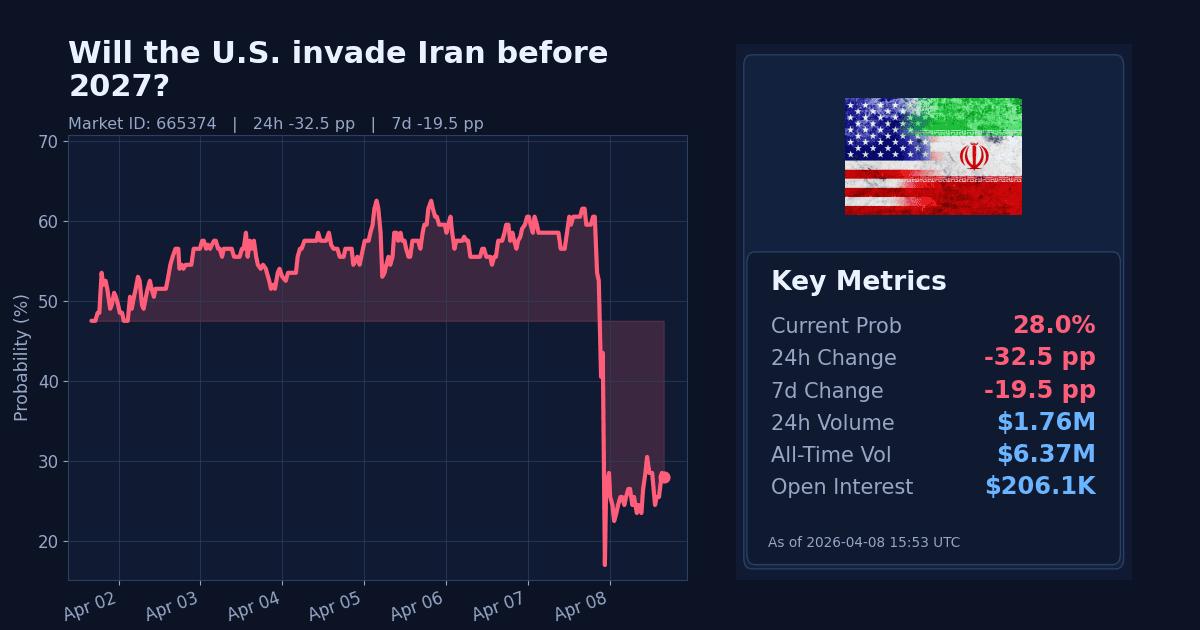
The Polymarket contract "Will the U.S. invade Iran before 2027?" dropped 32.5 percentage points over 24 hours to 28.0% as of April 8. Over the past week, it is down 19.5 points. The market resolves "Yes" only if the U.S. commences a military offensive intended to establish control over any portion of Iran by December 31, 2026, 11:59 PM ET.
This contract spans November 5, 2025 through December 31, 2026. Today’s repricing marks an abrupt downward move within that window.
Why It Likely Moved
- The repricing appears driven by a tentative two-week ceasefire involving Iran that took effect on April 8, pausing cross-border strikes and retaliatory operations, according to AP News.
- Government confirmation added weight: the UK government (Foreign Secretary statement published April 8) acknowledged a ceasefire between the US, Israel, and Iran.
- Terms indicating reduced immediate escalation risk—such as reopening the Strait of Hormuz for safe passage during the pause—were reported by NPR on April 8, aligning with lower invasion risk in the near term.
- Macro confirmation of de-escalation: WTI crude is at $95.16/bbl (down ~5% over 7 days), the S&P 500 is up ~3.0% over 7 days, and the VIX is down ~14% over 7 days, consistent with reduced geopolitical risk premia (figures as of April 8; see Yahoo Finance, S&P 500, VIX). AP News also reported a broad market rally and lower oil on the ceasefire.
How Strong the Move Is
The 24-hour decline registers as an extreme move relative to recent trading (24h z-score 3.65, labeled "extreme"). The 7-day change is also sharp (7d z-score 2.28). Together, these metrics indicate a significant, event-driven downdraft rather than routine noise.
Depth appears adequate: $1.76 million traded over 24 hours with a 1.0 pp spread, suggesting the shift was absorbed with meaningful liquidity.
Cross-Market Confirmation
- The “US x Iran ceasefire by April 7?” market surged +96.1 pp in 24h and +91.05 pp in 7d to 99.6%, confirming de-escalation signals aligned with the drop in invasion odds.
- “US forces enter Iran by April 30?” sits at 99.8% (+0.2 pp 24h; +48.25 pp 7d). This diverges from the invasion market and implies traders distinguish simple entry from an offensive intended to establish control.
- “US forces enter Iran by December 31?” is 99.8% (+0.1 pp 24h; +37.35 pp 7d), reinforcing the entry-vs.-invasion differentiation despite the current de-escalatory pause.
News & Real-World Context
- A tentative two-week ceasefire involving Iran took effect April 8, with diplomats working on verification and possible extension; enforcement and durability remain uncertain, per AP News (Apr 8).
- The arrangement includes Iran reopening the Strait of Hormuz to allow safe passage during the pause; President Trump said the U.S. and Israel would suspend bombing for the period, contingent on compliance, according to NPR (Apr 8).
- The UK government (Foreign Secretary statement, Apr 8) publicly addressed the ceasefire between the US, Israel and Iran, providing official confirmation. Separately, UK diplomats noted at the UN on April 7 that a related resolution did not pass, per a UK government explanation of vote.
- Broader policy scrutiny around Iran continued in Europe: the European Parliament published a written question on April 8 about potential circumvention of EU sanctions via Iranian-linked networks, and another on the Strait of Hormuz’s 12-nautical-mile rule on April 8 link.
- Risk assets rallied and oil fell on the ceasefire reports, per AP News (Apr 8). At the same time, not all fronts are covered by the truce: AP News (Apr 8) reported Israeli strikes in Beirut after indicating the Iran ceasefire does not apply there.
Bottom Line
An event-driven, extreme one-day repricing lowered the probability that the U.S. will invade Iran before end-2026. The move aligns with officially acknowledged, time-limited de-escalation and macro de-risking.
Given the ceasefire’s narrow scope and conditional terms, the shift looks primarily short-term rather than a structural reset of the contract through December 31, 2026.
Market Conditions at Time of Writing
- Current Probability (%): 28.0
- 24h Change (pp): -32.5
- 7d Change (pp): -19.5
- Volume (24h, $): 1,757,419.88
- Open Interest ($): 206,130.35
- Spread (pp): 1.0
- Z-score (24h): 3.6542