What Moved the Market
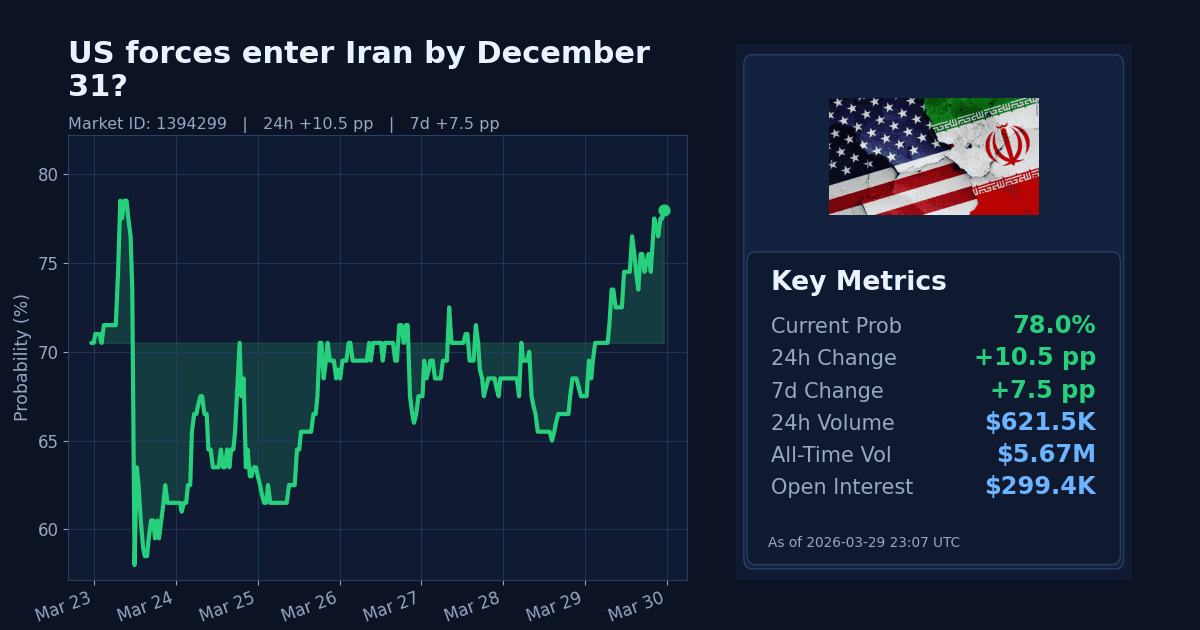
The Polymarket contract on whether active US military personnel physically enter Iran by December 31, 2026 (ET) repriced higher, with traders marking a notably stronger likelihood for a “Yes” outcome. The contract window runs from February 18, 2026 through December 31, 2026.
Over the last day and the past week, the market advanced decisively, now implying a high probability that US forces cross into Iran’s terrestrial territory within the contract’s timeframe.
Why It Likely Moved
- Repricing appears driven by coordinated, on-record diplomacy: G7 foreign ministers issued joint statements on Iran on March 27, 2026, published by the UK government and the French foreign ministry, signaling sustained allied focus on the conflict and its regional spillovers.
- Markets reacted to ongoing kinetic-operations signaling: the US government (Department of War) provided an Operation Epic Fury update on March 26, 2026, noting Israeli action against Iran’s IRGC Navy leadership amid ongoing Israeli and US strikes, per war.gov.
- Additional allied operational posture likely contributed: the UK government reported on March 28, 2026 that RAF personnel achieved multiple drone shootdowns during Middle East operations, protecting British interests and partners, underscoring active air-defense engagement in the theater (UK Ministry of Defence).
- Broader conflict signals framed the backdrop: AP highlighted concerns that “the war in Iran” is weighing on the global economy (March 29, 2026), and separately reported Iran‑backed Houthi forces escalating operations with risks to shipping, pointing to persistent regional hostilities (AP News; AP News).
- Diplomatic activity provides an offsetting note but also underscores severity: regional foreign ministers met in Islamabad aiming to de‑escalate the war involving Iran (March 29, 2026), according to NPR.
How Strong the Move Is
By historical standards for this contract, the latest daily and weekly gains register as extreme, indicating a sharp repricing rather than routine drift. The move reflects a spike in perceived odds.
Given that momentum is visible on both the 24-hour and 7-day horizons, the action looks like a forceful continuation rather than a transient blip.
Cross-Market Confirmation
- “US forces enter Iran by March 31?” fell 0.5pp (24h) and 1.0pp (7d), diverging from the main market’s rise and suggesting reduced conviction on ultra‑near‑term timing.
- “US forces enter Iran by April 30?” is priced at 71.0%, directionally consistent with elevated risk, but lacks current delta data to confirm the latest move.
- “US x Iran ceasefire by March 31?” remains at 1.6% with no recent change, a low‑ceasefire baseline that aligns with sustained tension implied by the main market.
News & Real-World Context
On March 27, 2026, G7 foreign ministers issued coordinated statements on Iran, published by both the UK government and the French foreign ministry, emphasizing the regional impact of the conflict and the need to protect civilians and critical infrastructure. These are primary policy signals of allied engagement.
Operationally, the US government provided an Operation Epic Fury update on March 26, 2026 that included Israeli action against an IRGC Navy commander amid continued Israeli and US strikes (war.gov). The UK government on March 28, 2026 reported RAF Regiment personnel shooting down Iranian drones during Middle East operations (UK MoD). AP News on March 29, 2026 highlighted heightened risks from Iran‑backed Houthi activity threatening global shipping, alongside broader economic concerns as the war in Iran persists (AP News; AP News). Regional violence also remained evident with reporting of a soldier’s death in southern Lebanon (AP News, March 29, 2026). Parallel diplomatic efforts to de‑escalate were underway in Islamabad, per NPR on March 29, 2026.
Macro indicators are consistent with elevated risk: Brent crude stands at $107.93/bbl, up 48.9% over 30 days despite a 3.8% weekly pullback, while the VIX is 31.05, up 56.3% over 30 days, pointing to a higher volatility regime.
Bottom Line
A sharp, policy‑ and operations‑linked repricing has lifted year‑end entry odds. Cross‑market signals show elevated medium‑term risk but less conviction on very near‑term timing.
Overall, this looks like a spike that resets the baseline higher rather than a fleeting move; timing remains uncertain.
Market Conditions at Time of Writing
- Current Probability (%): 78.0
- 24h Change (pp): 10.5
- 7d Change (pp): 7.5
- Volume (24h, $): 621,502.93
- Open Interest ($): 299,446.82
- Spread (pp): 1.0
- Z-score (24h): 12.0