What Moved the Market
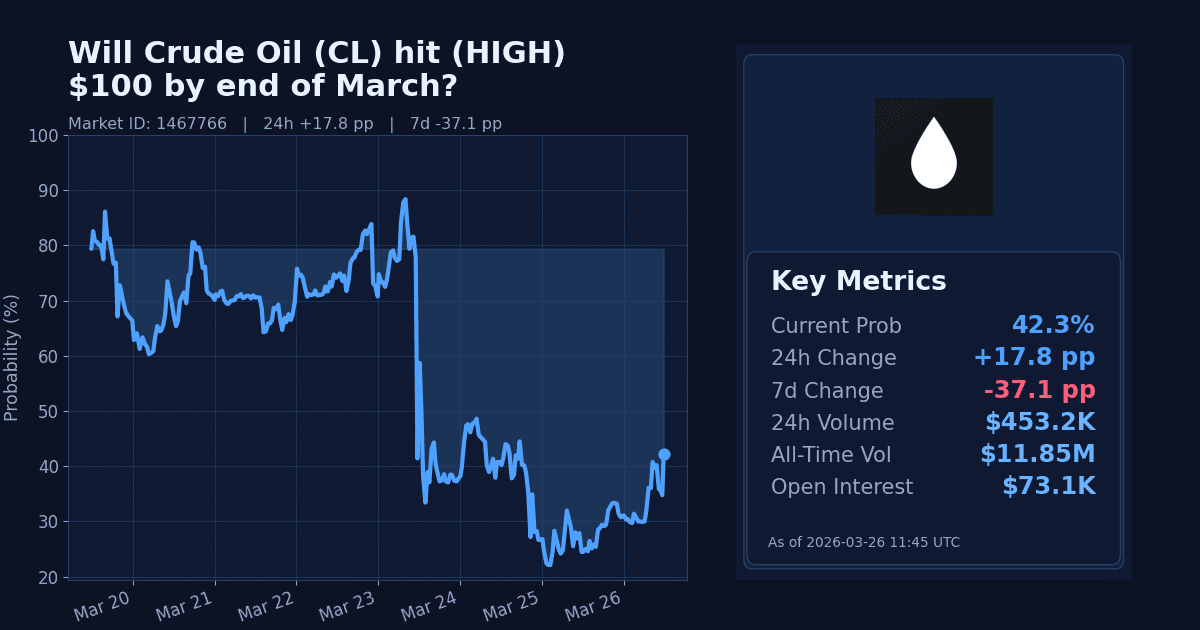
The Polymarket contract asking whether front-month CME WTI crude (CL) will settle at or above $100 on any trading day by March 31, 2026 moved higher. As of March 26, the market’s implied probability rose to 42.3%, up 17.85 percentage points over 24 hours.
This contract resolves on the official CME settlement price for the active month and ignores intraday prints. With the final trading day of March 2026 as the cutoff, traders have repriced the likelihood that a $100 settlement is reached before the window closes.
Why It Likely Moved
- Markets appear driven by persistent Middle East supply-risk headlines: oil “climbed again” as investors weighed uncertain de‑escalation prospects around Iran, according to AP News (Mar 26).
- Repricing follows reports that Iran has tightened control over the Strait of Hormuz, heightening shipment-risk for a key crude chokepoint, per AP News (Mar 26).
- Markets reacted to potential structural frictions after reporting on a draft law to formalize tolls on Hormuz transit by Iran, which could raise passage costs and uncertainty, per Ground News (Mar 26).
- The move also aligns with official signals: the UK government (Mar 25) issued statements at UNHRC 61 on Iran’s recent military aggression against Gulf states, and the European Parliament (Mar 25) assessed European Council outcomes covering defence/foreign affairs.
- Broader macro tone: the OECD (Mar 26) flagged an “energy shock” and heightened geopolitical risks, consistent with a firmer risk premium in energy markets.
How Strong the Move Is
The 24-hour rise of 17.85 percentage points is notable in size, but the platform’s z-score classification marks the move as normal relative to recent volatility. Over seven days, the contract is still down 37.1 percentage points, so today’s repricing is a rebound rather than a fresh breakout.
Given the normal z-score context, this looks like a volatility-consistent reversal attempt after last week’s decline. With WTI around $93.74/bbl (+42.8% over 30 days), the $100 settlement trigger is roughly $6 above current levels, keeping a binary outcome plausible within the remaining contract window.
Cross-Market Confirmation
- Will CL hit $120 by March? Probability at 4.6% (delta_24h: N/A; delta_7d: N/A). This low tail-risk pricing diverges from a full-blown supply-shock scenario, tempering confirmation of an extreme upside.
- US × Iran ceasefire by Mar 31: 12.0% (delta_24h: N/A; delta_7d: N/A). A low near-term ceasefire probability is consistent with elevated oil risk near month-end.
- US × Iran ceasefire by Apr 30: 45.0% (delta_24h: N/A; delta_7d: N/A). Higher odds of de-escalation into April could cap sustained upside beyond March, partially diverging from a prolonged push to $100.
- Cross-asset backdrop: VIX at 27.48 is up 14.2% over 7 days, indicating broader risk aversion consistent with a higher crude risk premium.
News & Real-World Context
On March 26, AP reported that oil “climbed again” as Asian markets weighed uncertain Iran de-escalation prospects and renewed supply concerns, while separately noting Iran’s firmer control over the Strait of Hormuz, a vital artery for crude shipments (AP News; AP News). A report the same day highlighted draft Iranian legislation to formalize Hormuz tolls, adding a prospective cost/risk layer to transit (Ground News, Mar 26).
Official statements reinforced the geopolitical frame: the UK government (Mar 25) and its follow-on statement (Mar 25) at UNHRC 61 addressed recent Iranian military aggression targeting Gulf states, while the European Parliament (Mar 25) reviewed the 19 March European Council outcomes on defence and foreign affairs. The OECD (Mar 26) cited an “energy shock” and rising geopolitical risks as weighing on the global outlook.
Additional reporting described broader disruption effects from the Iran conflict, including shipping-related fertilizer shortages and price spikes as the U.S. planting season begins, underscoring knock-on impacts of Gulf logistics stress (NPR, Mar 26).
Bottom Line
The jump in “Yes” odds appears tied to firmer supply-risk pricing around Iran and the Strait of Hormuz, corroborated by official UK and EU signals and the OECD’s energy‑shock framing. The move looks like a normal‑volatility reversal within a larger weekly drawdown, with spot WTI still several dollars below the $100 settlement trigger.
With only days left to March 31, the outcome hinges on whether geopolitical risk or logistics frictions can lift a CME front‑month settlement to triple digits before the window closes.
Market Conditions at Time of Writing
- Current Probability: 42.3%
- 24h Change: +17.85 pp
- 7d Change: -37.1 pp
- Volume (24h, $): 453,178.74
- Open Interest ($): 73,077.29
- Spread (pp): 1.7
- Z-score (24h): 0.0