What Moved the Market
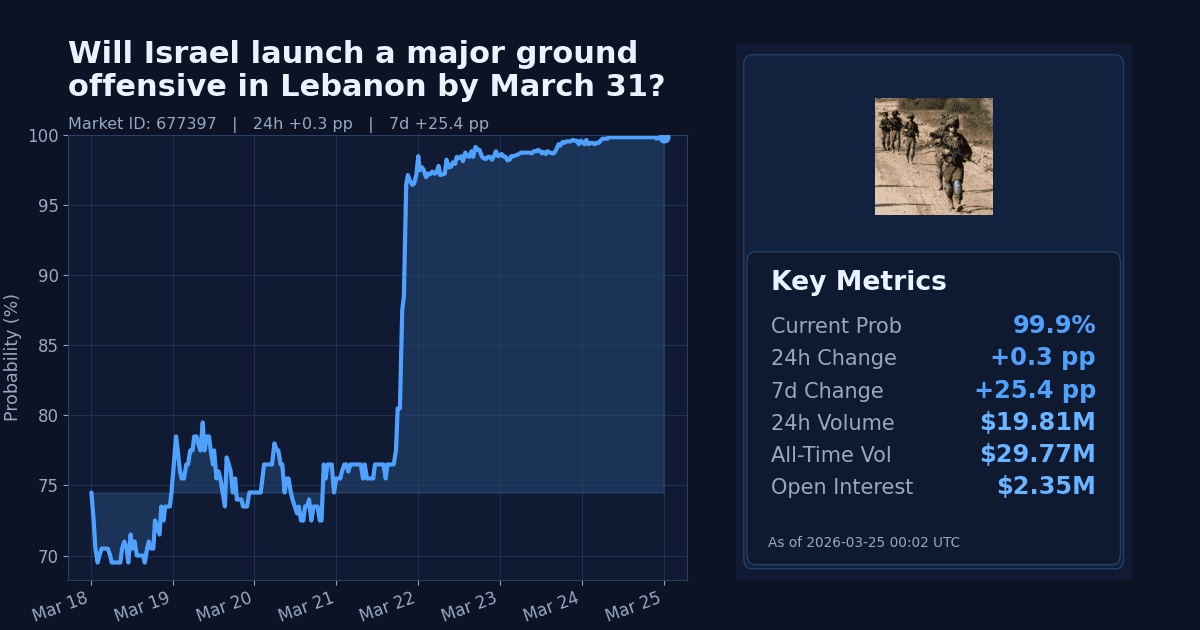
This Polymarket contract asks whether Israel will launch a major ground offensive in Lebanon by March 31, 2026, 11:59PM ET. Over the last week, the implied probability climbed by 25.4 percentage points to 99.9% as of March 25, 2026.
The 24-hour move was a modest +0.3pp, while liquidity stayed high and the bid–ask spread remained tight. The contract window began on November 13, 2025 and runs through March 31, 2026.
Why It Likely Moved
- Repricing appears driven by reporting that Israel’s military anticipates several more weeks of operations in the Iran war, keeping regional hostilities active close to the market’s deadline.
- Markets reacted to Lebanon ordering Iran’s ambassador out, signaling an intensified crackdown on Tehran’s influence that could affect dynamics along the Israel–Lebanon frontier.
- The repricing follows mixed de-escalation signals, with the U.S. said to be negotiating an end to the Iran war; traders may be front‑loading near‑term risk into the final week of the contract window.
- Elevated but easing energy markers—Brent crude near $100/bbl despite a roughly 3% 7‑day dip—frame persistent geopolitical risk consistent with higher odds of near‑term action.
How Strong the Move Is
By statistical measures, the move registers as extreme relative to the market’s recent trading, with both 24-hour and 7-day z-scores flagged as extreme. Despite the small day‑on‑day change, the week‑long repricing pushed the market to near certainty.
Given the proximity to the March 31 end date, this looks like a late‑stage, significant repricing rather than routine noise; today’s steadiness suggests consolidation at elevated levels.
Cross-Market Confirmation
- The market on whether the Iranian regime falls by March 31 sits near 1.2%, implying low expectations of systemic collapse and diverging from the near‑certainty priced here.
- A market on the U.S. announcing an end to military operations against Iran by March 31 trades around 21.0%, indicating uncertainty over imminent de‑escalation, partially consistent with elevated regional risk.
- Odds that U.S. forces enter Iran by March 31 stand near 16.0%, suggesting limited expectations of U.S. ground involvement—neither a clear confirmation nor contradiction of this market’s move.
News & Real-World Context
- Israeli military officials reportedly want several more weeks to pursue objectives in the Iran war, even as U.S. officials work to negotiate an end.
- Lebanon expelled Iran’s ambassador, escalating a postwar crackdown on Tehran’s influence.
- Coverage highlights sustained Israeli public support for the conflict, with some signs of softening.
- Diplomatic efforts include UN-level proposals on securing maritime chokepoints, reflecting broader regional spillovers.
- Analysts note possible talks to wind down the Iran war, but timelines remain uncertain.
Bottom Line
With less than a week until the March 31 deadline, traders have priced this market near certainty. The shift appears tied to ongoing war-related signals and Lebanese moves against Iranian influence, while de‑escalation efforts have not yet lowered odds. The move looks short‑term and deadline‑driven rather than structural.
Market Conditions at Time of Writing
- Current Probability (%): 99.9
- 24h Change (pp): +0.3
- 7d Change (pp): +25.4
- Volume (24h, $): 19,805,435.73
- Open Interest ($): 2,353,098.66
- Spread (pp): 0.1
- Z-score (24h): 6.0 (extreme)
- Z-score (7d): 16.855 (extreme)