What Moved the Market
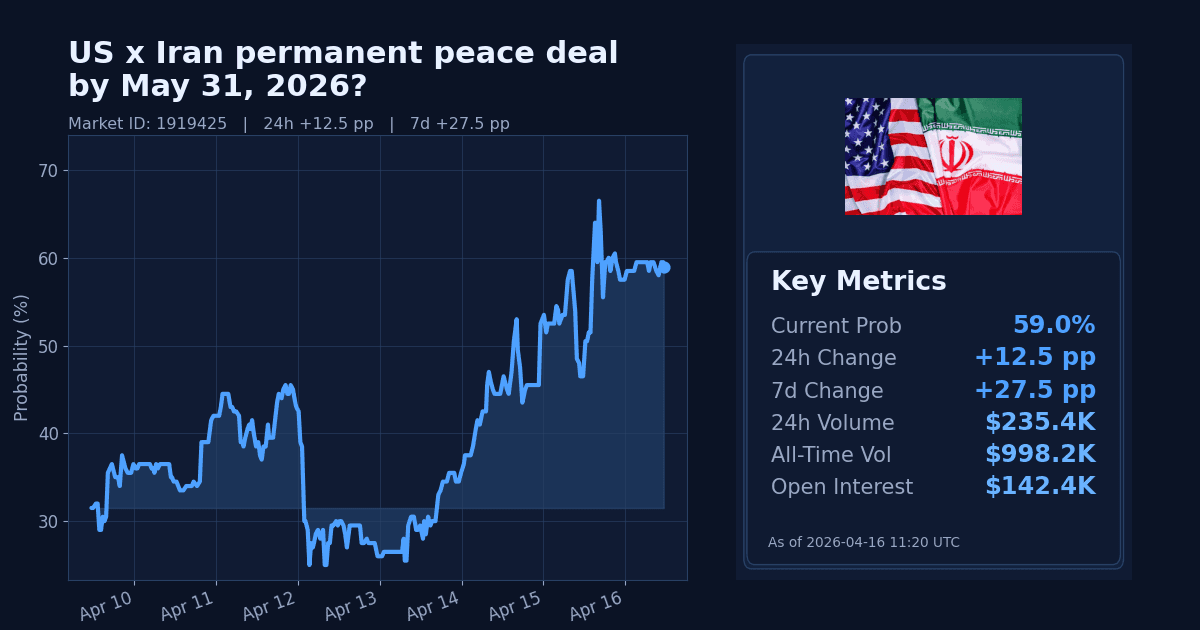
The Polymarket contract asking whether the United States and Iran will agree to a permanent peace deal by May 31, 2026 moved sharply higher, with pricing rising into the high‑50s.
The advance represents a double‑digit percentage‑point jump over 24 hours and a large week‑over‑week gain. The contract window runs from April 8 to May 31, 2026, and requires an explicit, lasting end to hostilities confirmed by both governments or a signed agreement.
Why It Likely Moved
- Repricing appears driven by reporting that US policy is pivoting from direct strikes toward intensified economic measures against Iran, led by Treasury sanctions and bank pressure, signaling a non‑kinetic emphasis (AP News, Apr 15, 2026).
- Markets reacted to the start of US naval patrols in the Strait of Hormuz aimed at constraining Iran’s oil revenue, reinforcing the focus on economic coercion rather than immediate battlefield escalation (NPR, Apr 16, 2026).
- The repricing follows congressional signals: Senate Republicans blocked an effort to halt Iran‑related military action while indicating possible future war‑powers votes, adding clarity on near‑term authority but leaving scope for subsequent oversight shifts (AP News, Apr 15, 2026).
- Official attention in Europe provided a diplomatic backdrop: the European Parliament hosted a debate with Iranian opposition voices (Apr 13, 2026) and issued written questions on Iran’s internal repression (Apr 15, 2026) and energy impacts from the conflict (Apr 14, 2026), signaling policy engagement (EP items: Apr 15; Apr 14).
- Traders may also be extrapolating from regional de‑escalation pricing: odds of an Israel–Hezbollah ceasefire rose sharply over the same period, aligning with a broader risk‑reduction theme.
How Strong the Move Is
By the numbers, this is an extreme repricing. The market rose 12.5 percentage points in 24 hours and 27.5 points over seven days. Both the 24h and 7d z‑scores are flagged "extreme," indicating the jump is outsized relative to recent trading.
Given the magnitude and statistical profile, this is best characterized as a sharp breakout rather than routine volatility, with a clear, week‑long trend higher.
Cross-Market Confirmation
- US–Iran permanent peace by Apr 30, 2026: up 7.0 pp (24h) and 24.5 pp (7d) to 39.0% — directionally aligns with the main move.
- US–Iran permanent peace by Apr 22, 2026: down 5.0 pp (24h) but up 5.0 pp (7d) to 17.0% — near‑term skepticism, but medium‑term improvement, a mild divergence in timing.
- Israel–Hezbollah ceasefire by Apr 30, 2026: up 24.25 pp (24h) and 24.15 pp (7d) to 60.9% — strong directional confirmation of regional de‑escalation expectations.
News & Real-World Context
- US policy signals: Reporting points to a shift toward financial tools — sanctions and pressure on banking networks — as primary levers against Iran (AP News, Apr 15, 2026). On Apr 16, NPR reported new US naval patrols in the Strait of Hormuz aimed at curbing Iran’s oil revenue, noting enforcement complexities and escalation risks (NPR, Apr 16, 2026).
- US domestic signals: Senate Republicans defeated an effort to restrict Iran‑related military action, while some indicated interest in future war‑powers votes, keeping oversight debates active (AP News, Apr 15, 2026). Separately, focus‑grouped Georgia voters voiced dissatisfaction with the Iran war’s trajectory, highlighting political pressure points (NPR, Apr 16, 2026).
- Government statements: The European Parliament hosted a debate with Iranian opposition (Apr 13, 2026) and tabled written questions on protester repression (Apr 15, 2026) and conflict‑linked energy costs (Apr 14, 2026) (EP Apr 15; EP Apr 14). The UK government issued a joint foreign ministers’ statement on Lebanon (Apr 14, 2026), underscoring regional diplomatic attention.
- Macro backdrop: Brent crude is $95.64/bbl (flat day‑over‑day, down 7.5% over 30 days), the US Dollar Index is 98.15 (down 0.68% over 7 days), and the VIX is 18.23 (down 6.5% over 7 days), suggesting no concurrent spike in broad market stress.
Bottom Line
This is an extreme, week‑long bullish repricing of a time‑boxed bet that requires an explicit, permanent end to US–Iran hostilities by May 31, 2026. The move aligns with reports of a US emphasis on economic pressure and with stronger regional ceasefire pricing, while near‑term military and political signals remain mixed.
Given the narrow contract window and the need for definitive government confirmation or a signed agreement, sustainability of the new pricing likely depends on further official statements or concrete diplomatic steps.
Market Conditions at Time of Writing
- Current Probability (%): 59.0
- 24h Change (pp): +12.5
- 7d Change (pp): +27.5
- Volume (24h, $): 235,403.48
- Open Interest ($): 142,439.17
- Spread (pp): 1.0
- Z-score (24h): 52.0