What Moved the Market
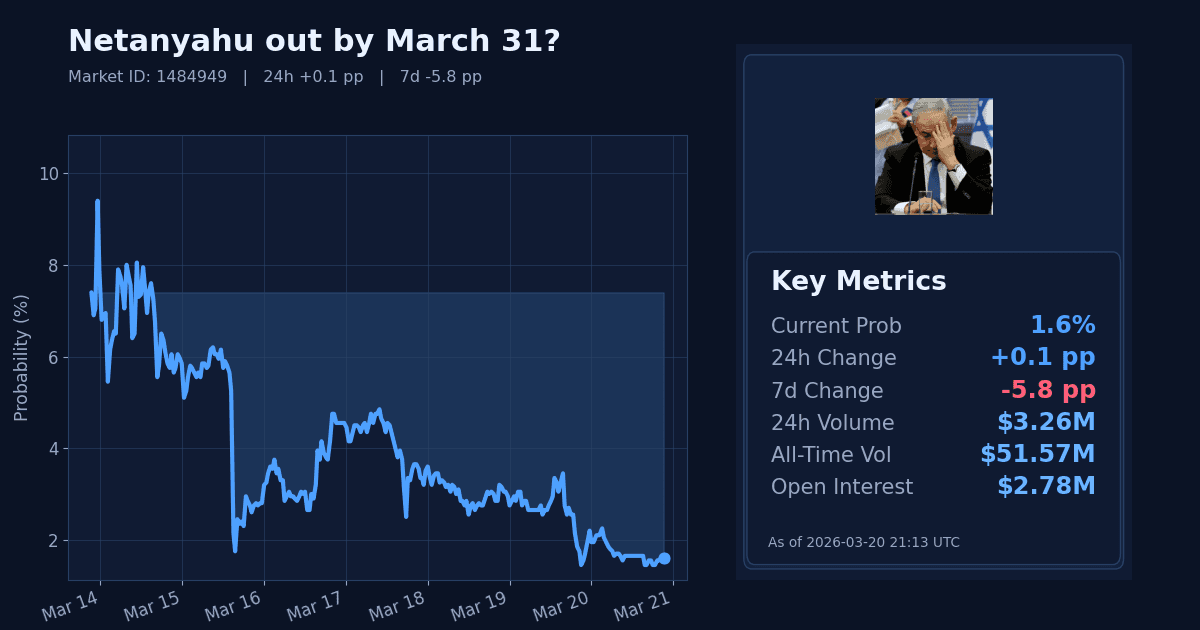
The market predicting whether Benjamin Netanyahu will cease to be Prime Minister of Israel by March 31, 2026, has seen a notable decline in the probability of a "Yes" outcome. Over the past seven days, the probability dropped from approximately 7.4% to 1.6%, indicating a reduced market expectation that Netanyahu will leave office within the contract window. The 24-hour change was minimal, suggesting the decline was gradual rather than driven by a sudden event.
Why It Likely Moved
- The market appears to have repriced downward amid ongoing Israeli military actions in the region, including recent strikes on Tehran, which may signal a consolidation of Netanyahu's position rather than imminent resignation.
- Continued fragile ceasefire conditions in Gaza and the absence of major political upheaval in Israel likely contributed to reduced expectations of a leadership change.
- Broader geopolitical tensions, such as the ongoing Iran conflict and its impact on regional stability, may have reinforced perceptions of political continuity.
- The lack of new credible reports or announcements regarding Netanyahu's potential resignation or removal during the market window likely suppressed probability increases.
How Strong the Move Is
The seven-day decline of 5.8 percentage points is a significant move given the low baseline probability, representing a substantial relative decrease in market-implied risk of Netanyahu leaving office by March 31. The 24-hour change was negligible, and the z-score over 24 hours is zero, indicating no recent volatility spike but rather a steady downward trend.
Cross-Market Confirmation
- Related markets on military action against Iran show elevated probabilities (34% to 43%), reflecting heightened regional conflict but do not directly imply imminent political change in Israel.
- The Iranian regime fall market holds a 25% probability, suggesting broader regional instability but no direct confirmation of Israeli leadership turnover.
- These related markets confirm ongoing regional tensions but diverge from the Netanyahu market’s declining probability, indicating that conflict escalation has not translated into expectations of Israeli political change.
News & Real-World Context
- Israel has recently launched strikes on Tehran following attacks on Gulf oil facilities, underscoring ongoing military engagement but no indication of internal political shifts.
- The fragile ceasefire in Gaza continues, providing some stability despite hardships, which may reduce immediate political pressure on Netanyahu.
- Global economic concerns, such as disruptions to fertilizer shipments through the Strait of Hormuz, add to regional complexity but have not triggered leadership changes.
- Brent crude oil prices remain elevated at $106.77 per barrel, reflecting sustained geopolitical risk but not directly affecting Israeli political dynamics.
Bottom Line
The market’s declining probability that Netanyahu will leave office by March 31 appears to reflect a short-term reassessment of political stability amid ongoing regional conflict. While tensions remain high, there is limited market evidence supporting an imminent leadership change within the contract window. This move is best interpreted as a structural repricing rather than a transient spike.
Market Conditions at Time of Writing
- Current Probability: 1.6%
- 24h Change: +0.15 percentage points
- 7d Change: -5.8 percentage points
- Volume (24h): $3,262,100.74
- Open Interest: $2,784,025.96
- Spread: 0.1 percentage points
- Z-score (24h): 0.0