What Moved the Market
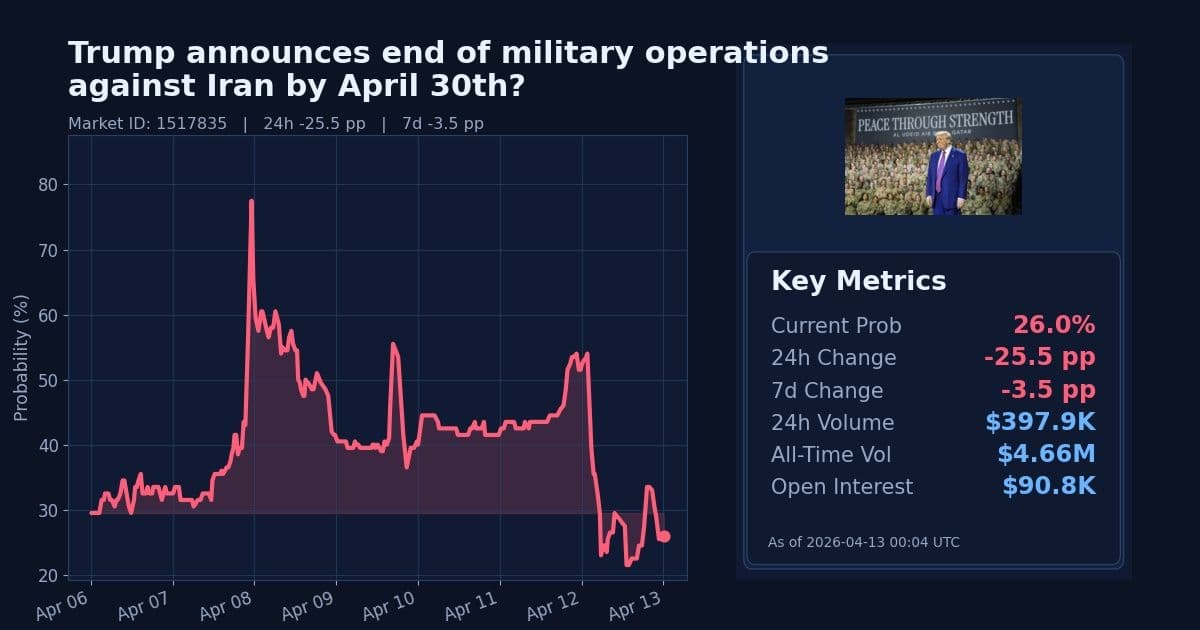
The Polymarket contract on whether President Trump will announce the end of U.S. military operations against Iran by April 30 fell sharply to 26%, down 25.5 percentage points over the past 24 hours. The one-day drop is classified as extreme by the platform’s z-score metric.
The market, which covers announcements clearly ending the operation that began on February 28, 2026, experienced elevated 24-hour volume and a tight spread as traders repriced the likelihood of a qualifying statement before the contract window closes on April 30 (ET).
Why It Likely Moved
- The collapse of U.S.–Iran talks in Islamabad was reported on April 12, with no agreement reached, reducing expectations for a rapid de-escalatory announcement before April 30, according to Axios and NPR.
- Axios also reported on April 12 that Trump announced a naval blockade on Iran following the talks’ failure, signaling a harder line that appears inconsistent with an imminent “end of operations” declaration (Axios).
- Earlier, officials confirmed a two-week ceasefire: the European Union published a joint leaders’ statement welcoming it on April 8 (European Commission), and the U.S. government reiterated the ceasefire on April 10 (U.S. government). The subsequent breakdown in talks appears to have outweighed prior de-escalation signals.
- Broader energy markets did not provide an offsetting de-escalation signal: Brent crude is $103.1/bbl and down 5.4% over 7 days, a move that did not prevent the sharp repricing in this contract.
How Strong the Move Is
The 24-hour decline of 25.5 percentage points is flagged as an extreme, event-driven selloff (24h z-score: 104.0). This indicates the move is outsized relative to the market’s recent trading history.
On a 7-day view, the contract is down 3.5 percentage points with an extreme downside z-score (16.0), suggesting the latest session concentrated most of the adjustment rather than reflecting a gradual trend.
Cross-Market Confirmation
- “Trump announces end of military operations against Iran by April 15th?” fell 10.0 pp in 24h to 7.0% (delta_7d: -6.0 pp), aligning with reduced odds of a near-term end-of-operations declaration.
- “US x Iran permanent peace deal by April 22, 2026?” dropped 10.0 pp in 24h to 8.0%, reinforcing diminished expectations for a formal de-escalation pathway in April.
- “US x Iran meeting by April 10, 2026?” ticked up 0.55 pp in 24h but is down 1.75 pp over 7d; this slight 24h rise diverges from the main move and is outside the current contract window.
News & Real-World Context
- U.S.–Iran talks in Islamabad ended without an agreement on April 12, according to Axios and NPR.
- Following the talks’ collapse, Trump announced a naval blockade targeting Iran, per Axios on April 12.
- Prior to this reversal, European leaders welcomed a two-week ceasefire between the U.S. and Iran on April 8, an official statement published by the European Commission.
- The U.S. government highlighted the same two-week ceasefire on April 10 in an official communication summarizing defense developments (U.S. government).
- Reporting on the fragility of the situation after failed talks underscored uncertainties around any durable resolution (AP News, April 12).
Bottom Line
Traders sharply cut the odds of a qualifying “end of operations” announcement by April 30 after the April 12 breakdown in talks and reported blockade signaling. Earlier official ceasefire statements did not translate into a pathway for a near-term end declaration.
The move looks event-driven and concentrated in one session. With the contract window closing April 30, pricing now reflects a materially lower probability unless a clear official statement emerges.
Market Conditions at Time of Writing
- Current Probability: 26.0%
- 24h Change: -25.5 pp
- 7d Change: -3.5 pp
- Volume (24h): $397,894.93
- Open Interest: $90,790.48
- Spread: 1.0 pp
- Z-score (24h): 104.0