What Moved the Market
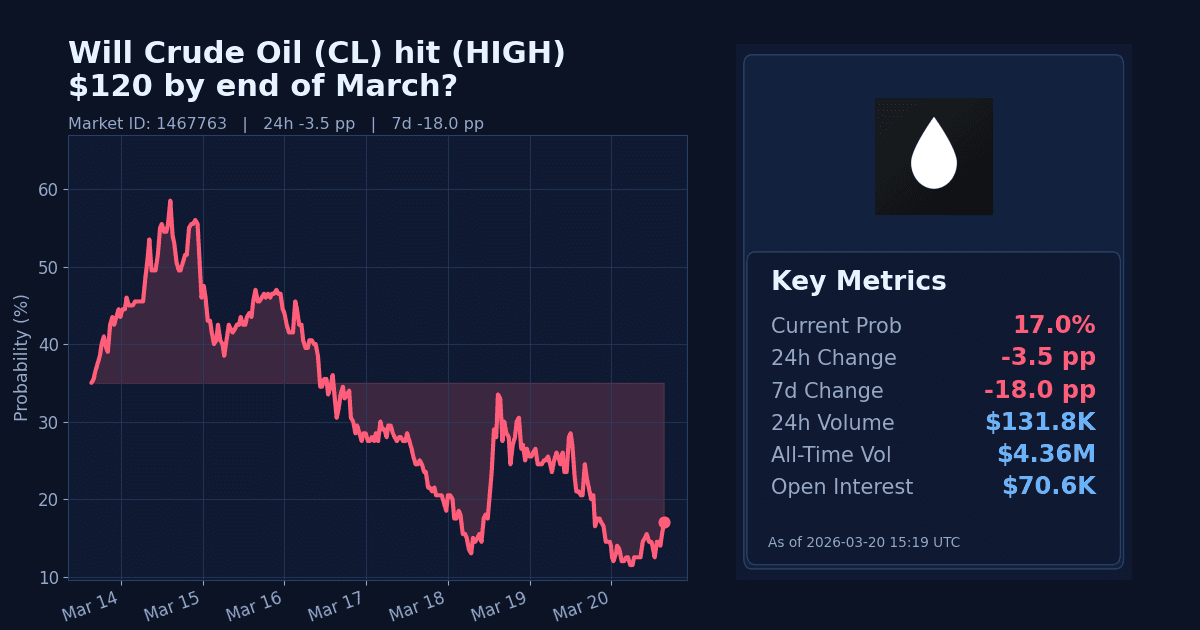
The market for the question "Will Crude Oil (CL) hit (HIGH) $120 by end of March?" experienced a notable decline in probability over the past week. The current probability stands at 17%, down 18 percentage points from seven days ago and 3.5 points lower in the last 24 hours. This indicates a reduced market expectation that crude oil futures will reach or exceed $120 per barrel by March 31, 2026.
The market has shown some short-term fluctuations, including a modest 2 percentage point increase in the last hour and a 1 point rise in the last 15 minutes, but the overall trend remains downward since mid-March.
Why It Likely Moved
- The repricing appears driven by recent crude oil price trends, with WTI crude currently trading around $96.87 per barrel, reflecting a 1.86% decline over the past week.
- Market participants may be reacting to ongoing geopolitical tensions in the Middle East, particularly conflicts involving Iran and disruptions in the Strait of Hormuz, which continue to influence oil supply concerns.
- Despite these tensions, the lack of a sharp upward move in crude prices suggests tempered expectations for a spike to $120 within the contract window.
- The recent Israeli strikes on Tehran and Iran's attacks on Gulf oil facilities contribute to uncertainty but have not pushed prices decisively higher.
- Broader economic factors, including slowing world trade growth projected by the WTO, may be weighing on demand expectations and thus on price forecasts.
How Strong the Move Is
The 18 percentage point drop over seven days represents a significant market adjustment rather than noise or a minor fluctuation. The 24-hour z-score of 0.0 indicates that the recent daily change is within normal volatility bounds, suggesting the move is part of a broader trend rather than a sudden spike or reversal.
Cross-Market Confirmation
- The related market assessing whether crude oil will hit $200 by the end of March shows a very low probability of 1.1%, consistent with the downward reassessment of extreme price spikes.
- Markets related to military actions involving Iran show elevated probabilities (38% for another country conducting military action by mid-April and 99.4% for Iran taking military action on March 20), confirming ongoing geopolitical risk but not translating into higher crude price spike expectations.
News & Real-World Context
- Governments, including European nations, Japan, and Canada, have announced coordinated efforts to secure the Strait of Hormuz, aiming to mitigate supply disruptions.
- Despite these efforts, oil and gasoline prices remain elevated due to persistent regional instability and logistical challenges.
- Recent Israeli military strikes on Tehran and Iranian retaliatory attacks on Gulf oil infrastructure maintain a backdrop of conflict that influences market sentiment.
- The WTO forecasts a slowdown in world trade growth to 1.9% in 2026, which may dampen global oil demand expectations.
- WTI crude oil prices have declined slightly over the past week, reflecting these mixed signals.
Bottom Line
The market's downward adjustment in the probability of crude oil reaching $120 by the end of March appears to reflect a cautious reassessment amid ongoing geopolitical tensions and modest declines in crude prices. This move suggests a short- to medium-term recalibration rather than a structural shift, with uncertainty remaining high due to regional conflicts and economic factors.
Market Conditions at Time of Writing
- Current Probability: 17.0%
- 24h Change: -3.5 percentage points
- 7d Change: -18.0 percentage points
- Volume (24h): $131,759
- Open Interest: $70,646
- Spread: 1.0 percentage point
- Z-score (24h): 0.0